



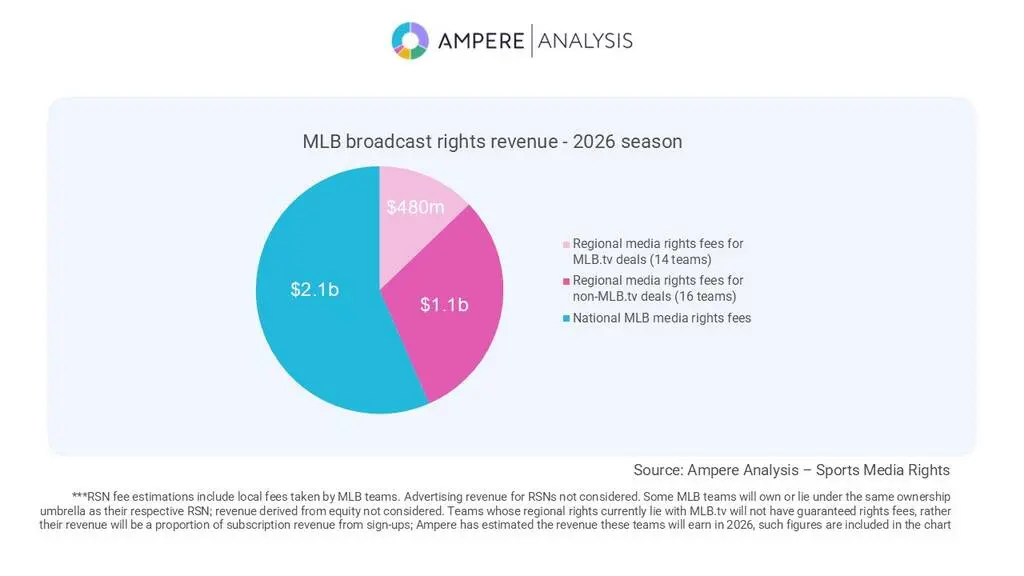
Major League Baseball’s (MLB) regional broadcast rights are worth $1.6bn in 2026, despite the collapse of the traditional cable model, according to Ampere Analysis.
The figures will likely provide relief to the baseball league and its teams, highlighting the resilience of the league’s broadcast business as US sports rights holders make the change from pay-TV to streaming.
Regional sports networks (RSNs), which pay teams to broadcast games locally, are under pressure as viewers abandon cable. Despite the disruption, regional rights account for 43% of MLB’s total $3.7bn broadcast revenue, with national TV deals generating a further $2.1bn.
The decline of traditional pay-TV continues to erode the model, with Ampere Analysis estimating that US pay-TV households will fall from 96 million in 2016 to 65 million by the end of 2026, while streaming households rise from 57 million to 112 million.
As audiences dwindle, RSNs have struggled to meet their rights-fee commitments, prompting the league and its teams to find new ways to bring games to viewers.
MLB.tv fills the gap left by regional networks
Over the past four years, 13 of MLB’s 30 teams have lost regional sports network partners, including 12 tied to the bankruptcies of Diamond Sports and Main Street Sports Group.
MLB has stepped in to fill the gap, with its MLB.tv service holding regional broadcast rights for 14 of the league’s 30 teams during the 2026 season and streaming games to consumers without local blackouts.
The situation has widened the financial gap between teams, with Ampere estimating that the 14 clubs partnered with MLB.tv account for around 30% of total regional non-advertising television revenue, having previously benefited from more lucrative RSN agreements.
Unlike those deals, MLB.tv links broadcast fees to subscriber numbers and doesn’t guarantee fixed payments, making it an interim solution that has yet to match the value of traditional regional contracts.
Teams in larger markets still hold the advantage, with bigger local audiences and a larger pool of potential subscribers to capture. Ampere Analysis estimates that the Los Angeles Dodgers and New York Yankees account for an estimated 23% of MLB’s total regional rights fees.
2028 rights cycle could change the market
MLB is targeting its next media rights cycle in 2028 to centralise local broadcasting rights, which could enable the league to sell games collectively to a streaming platform on a national basis.
A consolidated package would give broadcasters a substantial volume of live sport from one of the “big four” US leagues in a single deal, as well as provide MLB with more control over distribution as viewing habits continue to move away from cable.
The league is also facing pressure over the financial gap between its biggest and smallest markets. Greater revenue sharing could follow the expiry of MLB’s collective bargaining agreement with the MLB Players Association at the end of 2026, which could narrow the disparity between clubs.
Ampere forecasts that US pay-TV households will fall further, to 58 million by 2031, while streaming households climb to 120 million.

Such disruption isn’t limited to baseball, with Main Street Sports Group’s collapse also leaving 13 NBA teams needing new broadcast arrangements ahead of the upcoming 2026/27 season. DAZN has since acquired regional streaming rights for several NBA teams.
The NHL has also faced similar restructuring, announcing in July that NHL Productions will provide services for the Carolina Hurricanes, Columbus Blue Jackets, Minnesota Wild and St. Louis Blues this season.
It has also led leagues to make leadership changes, with the NHL hiring Rob McGlarry to lead NHL’s media strategy going forward.
McGlarry was named General Manager of Local Media earlier this year, a role that will see him supervise the expansion of its centralised production operation.