



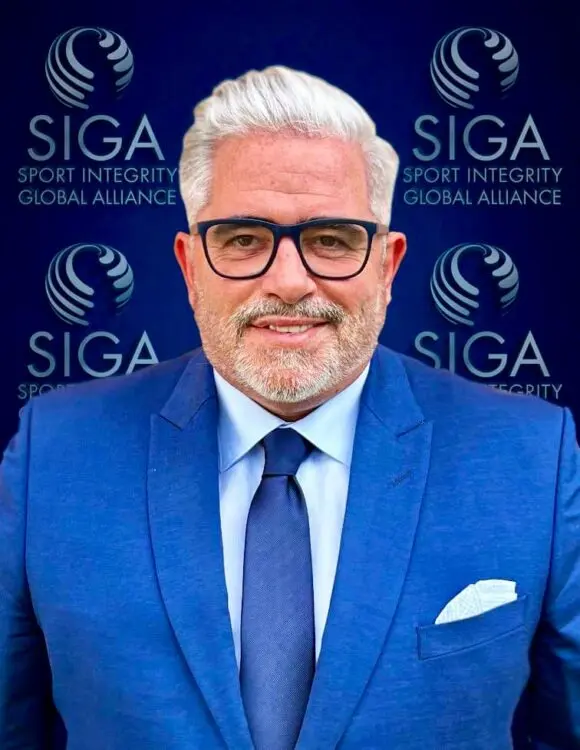
Ahead of an exclusive interview with Insider Sport, Senior Journalist Kieran O’Connor recalls his interview with SIGA Global CEO Emanuel Medeiros on why football cannot hide behind autonomy to avoid independent scrutiny.

When I got out of bed last Tuesday, it didn’t feel any different from any other, except maybe the morning was a bit darker than the week before. Traffic was still abysmal. I listened to the same playlist as always and sat down at the desk I have had for the past year and a half.
My first port of call was the calendar.
“Insider Sport x Emanuel Medeiros” at 9.30am woke me up better than any coffee could. It wasn’t a surprise, as the interview to discuss football governance had been arranged the previous week and my questions were ready to go.
However, having read an article by Medeiros during my preparations and learning about his storied career across UEFA, FIFA, and now the Sport Integrity Global Alliance, I knew I couldn’t afford to be half-asleep.
I was right. Within minutes of logging on, he admitted he was shocked by my accent because he assumed I was from Boston, Massachusetts. I didn’t question how he arrived at that conclusion because the only real explanation was that he had done his homework, spotting where I had studied.
It was this meticulous preparation that set the tone for everything that followed.
The paradox of success
Football finds itself in an extraordinary paradox. The sport has never generated more money, attracted larger broadcast audiences or occupied more cultural real estate. FIFA is expected to generate more than $15bn in revenue across the 2023–2026 cycle.
Despite this commercial success, some of the fixtures fans have followed most closely this season have been played in courtrooms, boardrooms and regulatory hearings. Transfer gossip has also turned into speculation over which superstar legal team each side has signed.
“Sport has evolved tremendously,” Medeiros explained. “But regulation and the supervision and the scrutiny have not followed the pace of change. This generates a myriad of opportunities, but also extremely complex, sophisticated and global challenges.”
He made a superb analogy, comparing football to the airline industry and other heavily regulated sectors.
Independent bodies regularly inspect planes for safety, ensuring that no corners are cut in pursuit of greater profit. Football at the global level doesn’t have this kind of safeguard. Multimillion-pound deals can be made without clarity and controversial policies like dynamic ticket pricing can be pushed through overnight without executives needing to answer to anyone.
Medeiros, showing his legal prowess, posed an uncomfortable question.
“Why should sport still be governed and operated with the mentality of the 19th century when we are in 2026?”
Custodians, not owners
It is easy to see why those sitting comfortably at the top of the pyramid might resist changing the status quo, but Medeiros turned the premise completely on its head.
“Why would any sport organisation be afraid of independent scrutiny? Independent scrutiny is exactly the opportunity they have to show the whole community that they are governing themselves and operating under the highest integrity standards,” he pointed out.
“So people can continue to invest their passion, their money and their reputation.”
Why the resistance then? The answer lies in the sport’s foundational culture. For over a century, the game has operated inside a bubble, guarding its independence from the outside world.
Medeiros understands that impulse better than most, having spent his early career fighting for sporting specificity and subsidiarity. Even so, he rejects the assumption that autonomy grants governing bodies a license to operate without scrutiny.
“The principle of autonomy of sport is the backbone of what sport is and what it stands for,” he said. “Autonomy is a responsibility. Autonomy implies a set of sine qua non conditions that are absolutely essential.”
Among those conditions, Medeiros stressed, are genuine democracy, real term limits that don’t keep being pushed back, and robust checks and balances that separate executive authority from judicial oversight. Most of all, he argued that those leading the game need a change in mindset.
“Those who are elected are elected to serve the game, not to take advantage. Every sport executive is a custodian. They don’t own the game. In their temporary role, they have the game’s values. They must do everything to leave their organisation better than they found it.”

The silence of the sponsors
Perhaps the most thought-provoking part of our discussion was on commercial backers, a particular interest of mine as I run a weekly feature called Partnership Playbook.
Sponsorship is vital to modern football’s economic model. It sits at the very heart of the Premier League’s case against Manchester City, where years of alleged financial irregularities, commercial contracts and artificial inflation have spent months under the microscope.
Before speaking with Medeiros, I had never fully considered how football administrators operate without the baseline external checks expected in almost every other global business.
In press releases, corporate partners brag about how closely their values align with the sport. However, when scandals come to light, controversial decisions are made behind closed doors and independent governance is nowhere to be seen, brands stay quiet.
Medeiros recalled a private conversation with the chief executive of a global brand who explained the anxiety.
“There is something that keeps me up at night,” the CEO told him. “And that is the fear of reputational damage, because we don’t have any means to show the evidence to show that that organisation’s assurances are fit for purpose. And if something happens, it’s not just the consumers, it’s my shareholders. My shareholders are paying attention.”
Of course brands won’t know about every shady deal a club or governing body does, but at the moment there isn’t any way of knowing, so should they not be fearful of the unknown? Would they slap their logo on a plane if it hadn’t undergone safety inspections?
The cost of inaction
As our video call cut out and I turned back to the rest of my working day, I couldn’t shake the points he brought up. Perhaps it was his expertly delivered arguments, but I couldn’t stop thinking about why I’d not noticed this before.
The European Super League crumbled to fan pressure, and without fans, football is nothing. But are we enough to stop the next European Super League, or do we need proper governance to ensure it doesn’t make it out of the boardroom?
The full Q&A with Emanuel Macedo de Medeiros will be published on Insider Sport on 9 November at 9am.