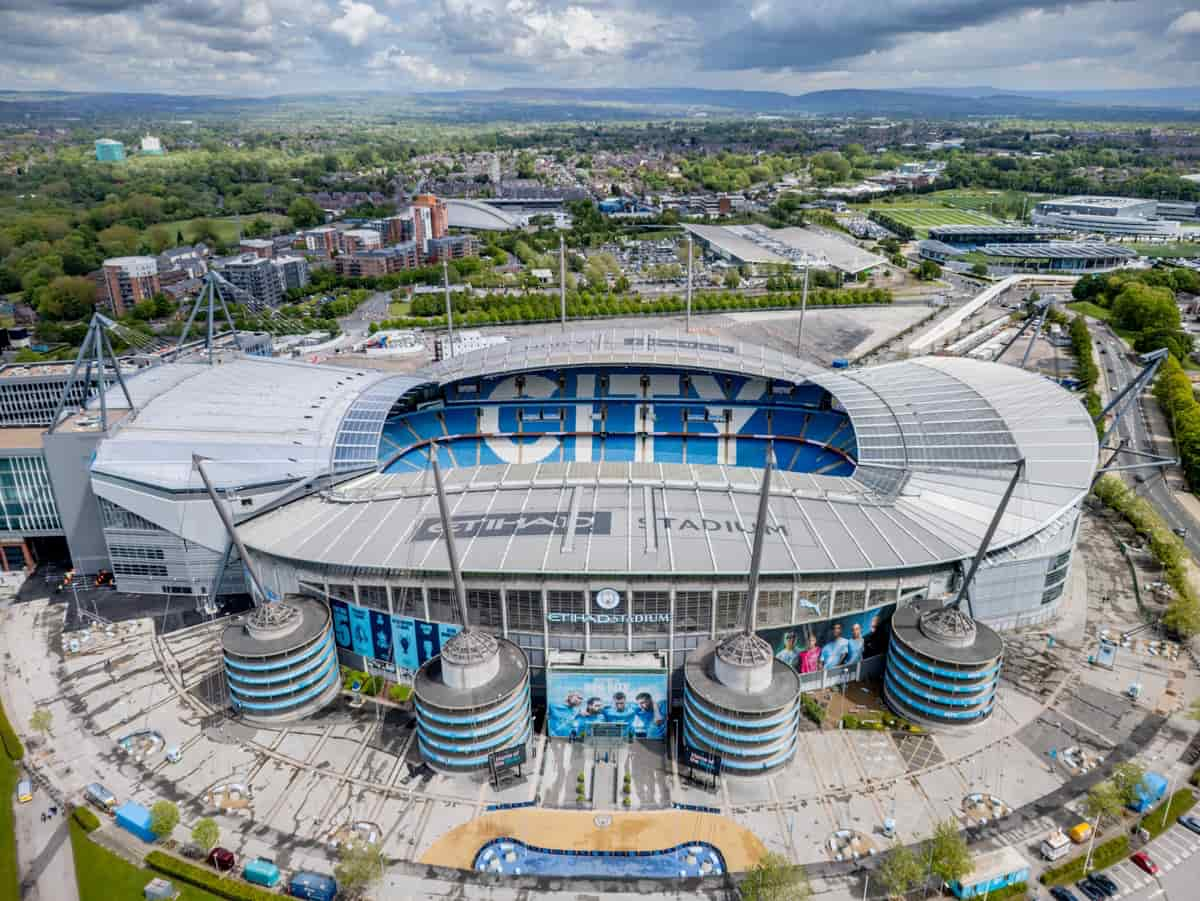



Manchester City’s appeal to its guilty verdict of breaking 114 financial Premier League rules is set to be revealed next year as sanctions await which has banks affiliated with the club cautious.
Manchester City will learn the sanctions from its guilty verdict of breaking 114 Premier League financial regulation charges next year if its appeal is unsuccessful.
The club was found guilty in September of artificially inflating sponsorship revenue from 2009 to 2018 by up to £900m, but Manchester City officials continue to plead their innocence and lodged an appeal on 1 October.
Ferran Soriano, CEO of Manchester City, claimed the Premier League’s ‘sham’ statement on 29 September is “based on a single false accusation – that the owner’s personal money was somehow and secretly put into the club via some sponsors from Abu Dhabi”.
An appeal process following a verdict from the Premier League’s process for arbitration and judicial proceedings typically takes up to 12 weeks to complete. This means Manchester City’s appeal could end mid-to-late January 2027.
The appeal process is set to begin in mid-December and could take up to days to be finalised, according to people close to the matter cited by The Financial Times.
An independent appeals board will pass down its verdict to an independent commission, and if Manchester City’s appeal proves to be unsuccessful, the commission can impose sanctions that range from financial penalties, points deductions and transfer embargos.
Sources told The Financial Times that the sanctions could be announced before the appeals process has concluded, but it is unknown when the sanctions will come into effect.
Manchester City currently sit third in the Premier League table.
The club’s appeal strategy, led by Lord Pannick KC, was revealed in reports in October. Manchester City will claim the sponsorship revenue was not artificially inflated and funded by Abu Dhabi United Group (ADUG), rather, they were funded by government grants which is allowed under current Premier League rules.
Manchester City will also use the same 24 witnesses’ testimonies used in the initial commission’s investigation to prove to the appeals board that the commission overlooked this evidence.
Banks beginning to pull away from Manchester City
Banks are also awaiting the verdict of the appeal case as Bloomberg reported recently that lenders financing Manchester City’s transfer dealings are stepping back if the guilty verdict is upheld.
The report revealed that banks are stepping back away from the club in order to preserve its reputational and credit reputation. One lender connected to the club, Oldenburgische Landesbank AG, has already pulled out of financing Manchester City’s £34m signing of Allan Elias from Palmeires which was confirmed last summer, according to people close to the matter cited by Bloomberg.
Premier League clubs such as Manchester City call on lenders to pay transfer receivables up front while financing low-cost interest back to the bank.
According to findings from the English Independent Football Regulator’s ‘State of the Game’ report, 94% of all lending to banks for transfer funds by football clubs in England since the 2020/21 season have involved just five banks.
These transfer payments are also split across several years and has been a strategy often deployed by Premier League clubs.
Amortisation as it is commonly known, allows clubs to split the full transfer sum across several years in order to comply with Premier League financial regulations and not exceed the loss threshold of the previous Profit & Sustainability Rules (PSR), which have since been replaced with Squad Cost Ratio (SCR) rules.
Officials from UEFA however have warned that amortisation could soon prove to be financially unsustainable, which was also noted as a cause for concern within the IFR’s State of the Game report.
In the 2025/26 season, English clubs owed £4.8bn in transfer fee instalments according to the report, while only expecting £1.5bn in transfer fees incoming. This means there is a net transfer fee debt of £3.4bn across all English football clubs.