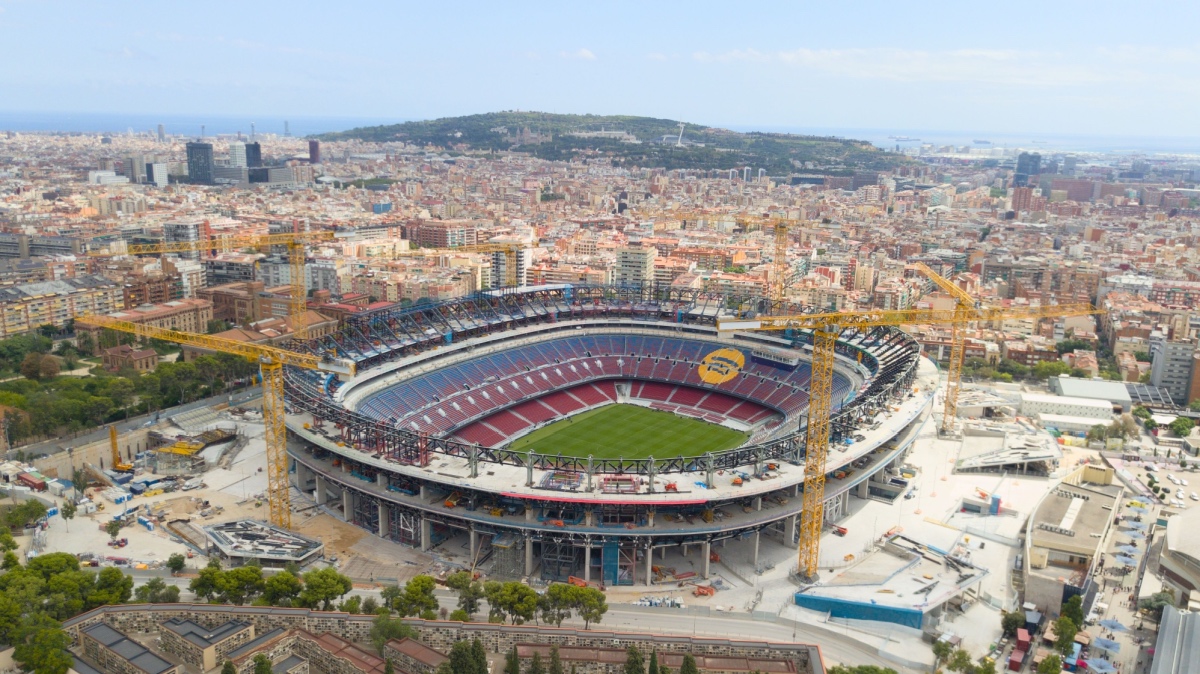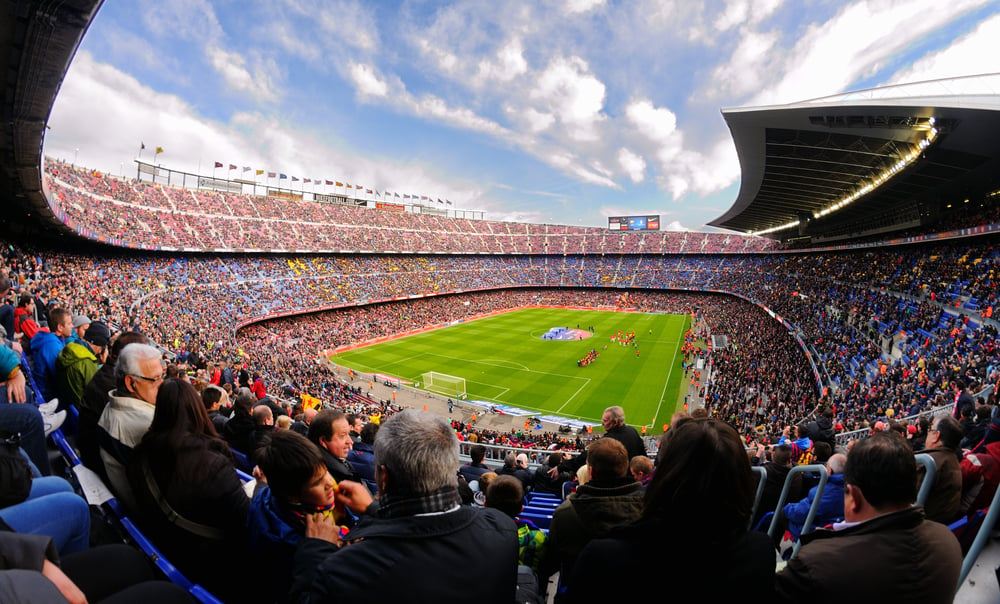



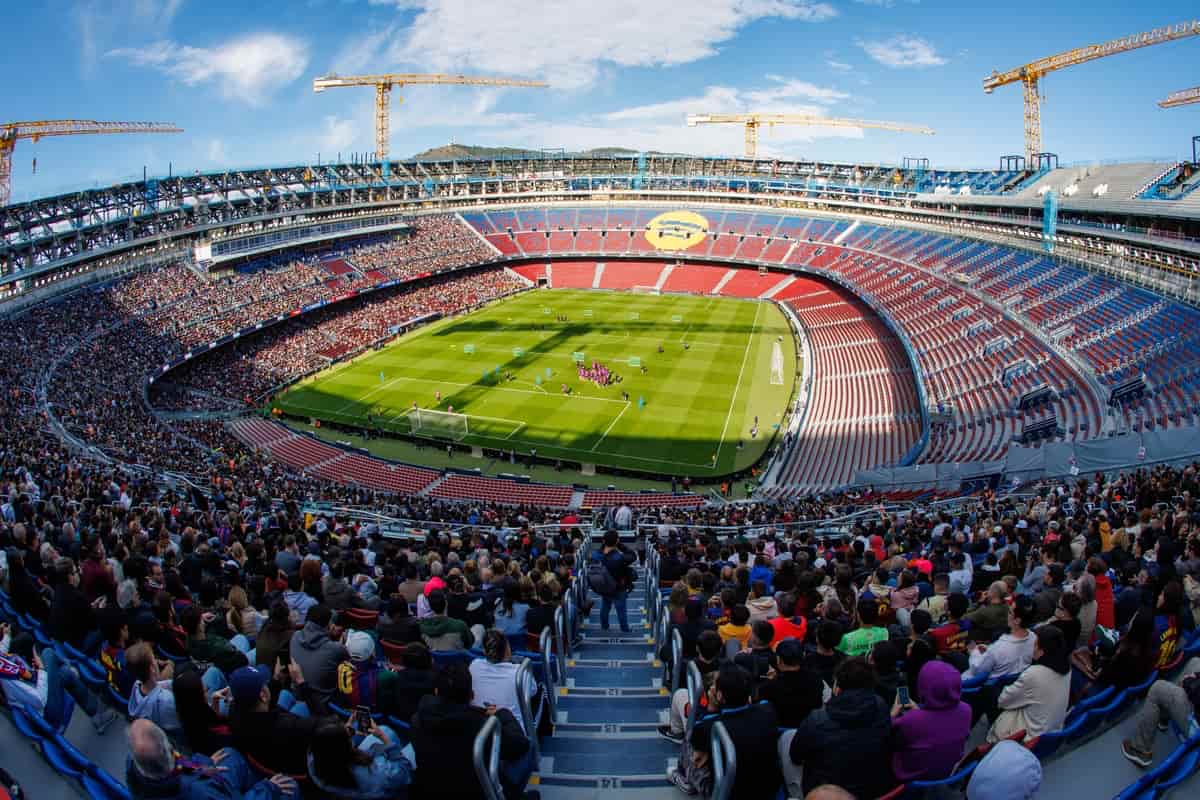
The Blaugrana is heading into the final stretch of completing all of its work on its home stadium of the Camp Nou, and has forecasted record revenues as FC Barcelona are set to leave and return to Camp Nou in 2028.
FC Barcelona has confirmed it has approved a new $589m (€510m) financial package to complete the renovations to its home stadium; the Spotify Camp Nou.
However, in a bid to complete renovations to the Camp Nou, FC Barcelona will start the 2027/28 season at the Olympic stadium, the Estadi Olímpic Lluís Companys stadium, before a planned return to the ‘new’ Camp Nou in January 2028.
The current maximum capacity at the Camp Nou is 62,000 while renovations continue. FC Barcelona is projecting a maximum capacity of 104,600 seats once the stadium completes its entire renovation in 2028.
The financial package, which was approved by delegate members during a club Annual General Assembly Meeting, is broken into two components; €300m for the completion of construction work of the stadium and €210m reserved for two Media Notes issuances, backed by the club’s audiovisual revenues.
The €300m will be used to build new facilities, services, and technological solutions both inside and outside of the Camp Nou, including the continuation of a new stand that the club stated has “required far more work than originally anticipated”.
In addition to the new stand, work will continue to include new VIP and hospitality areas, increased space for the FC Barcelona museum, enhanced 5G connectivity solutions via its partnership with Spotify, and advanced building management systems.
The remaining €210m will be raised through two Media Notes issuances of €105m each. The first was issued in July 2026, with the second scheduled for October or November 2026. Both issuances have maturities of up to 10 years, carry fixed interest rates, and are secured against future audiovisual revenues generated from La Liga and UEFA competitions.
Another financial hit returning to Olympic stadium
The Catalonia football club admitted a return to Montjuïc will cause a minor financial setback as it will miss out on the added gate revenue the Camp Nou brings as a larger stadium.
From 2023 to November 2025, the club played all home fixtures at the Estadi Olímpic Lluís Companys stadium while ground broke on the renovations to the Camp Nou.
FC Barcelona revealed that during the two full seasons it played at the Olympic stadium, it incurred €17m in operating expenses, while generating €24m in investments.
Furthermore, with the newly approved €510m package approved by club members, this brings the total figure of the amount spent on the Espai Barça project which encompasses the new stadium, up to €1.5bn.
Barcelona revealed it has refinanced more than €500m in a bid to smoothen its debt service profile and improve its financial position. The club insists its debt reserves are strengthened by the refinancing and will be essential to complete the Epsai Barça project.
Why the ‘new’ Camp Nou offers Barcelona a new revenue stream
The club announced once the team has returned to the Spotify Camp Nou, not only will this generate significantly more in gate revenue from ticket sales, but the club expects the stadium to contribute to a projected €1.45bn revenue by the end of the 2030/31 season.
During the 2025/26 season, the club posted revenues of just over €1bn and €184m in EBITDA, a marginal revenue increase from €994m in 2024/25 and a slight decrease in EBITDA from €191m.

In a bid to continue to scale revenues, FC Barcelona signed a new partnership agreement with Telefónica to become the club’s official ‘TV Network Broadcast Integrator’ in a five-year deal.
Like many new Barcelona sponsoring partners, Telefónica has its own dedicated executive box at the Camp Nou and will also have brand signage across its lounge spaces.
Joan Laporta, President of FC Barcelona, said: “This partnership will allow us to continue working towards an increasingly connected and innovative Spotify Camp Nou and will help us offer the best possible experiences to our members and fans in general.”
Barcelona have had to watch their fierce rivals Real Madrid make consecutive record revenue financial years due to the renovations to the Santiago Bernabeu.
Real Madrid’s 2025/26 financial results revealed the new Santiago Bernabeu generated revenue of €363m, more than double than what it was in the season prior. The club posted a revenue of over €1.2bn last season.
The Bernabeu is able to generate additional revenue for Real Madrid due to hosting musical concerts from artists such as Taylor Swift and NFL international series games, diversifying its revenue stream and leveraging its stadium as a commercial property.
FC Barcelona will intend to do the same approach and its first test of how accommodating the ‘new Camp Nou will be is for the 2029 UEFA Champions League Final, its first in 30 years.