



LaLiga giants post €1.185bn in revenue and record EBITDA as stadium and commercial operations drive growth
Real Madrid has underlined its status as world football’s commercial powerhouse by posting record revenues of €1.185 billion for the 2024/25 financial year, marking the second consecutive year the club has broken the billion-euro barrier, a feat unmatched by any other football team to date.
The 10.4% year-on-year revenue increase, which excludes income from player transfers, builds on the €1.073 billion figure reported in 2023/24. The club also reported a record EBITDA of €243 million and a net profit of €24 million, highlighting not just topline growth but enhanced operational efficiency.
One of the primary drivers behind the financial uplift was the first full year of unrestricted stadium operations following the extensive Santiago Bernabéu renovation works. Recurring revenues from stadium capacity and commercial operations grew by 38% year-on-year, excluding the “personal seat license” scheme, which saw reduced seat sales compared to the previous year.
This growth was supported by a return to full matchday functionality and the ramping up of ancillary business lines such as merchandising, sponsorships, and corporate hospitality. Catering and concerts, however, remain partially restricted and are expected to contribute more significantly from 2025/26 onwards.
Commercial momentum and competition income offset broadcast dip
All business lines saw year-on-year growth with the exception of broadcasting, which fell slightly due to reduced LaLiga distributions and the removal of UEFA’s market pool under a new revenue-sharing model.
However, increased income from competitions – including friendlies, the Copa del Rey final and the first half of the FIFA Club World Cup – helped to mitigate this decline.
Meanwhile, commercial activity surged. The club significantly boosted its sponsorship and merchandise income, including new headline deals during the financial year. The strong squad composition and on-pitch competitiveness also played a role in maintaining the club’s brand value.
Profitability reaches new highs
Real Madrid’s EBITDA before disposals stood at €208 million, a 45% rise from the €143.6 million recorded the previous year. Including €35 million from player and asset disposals, EBITDA reached €243 million — the highest in club history and a 55% improvement on the €156.3 million achieved in 2023/24.
Profit after tax rose 56% to €24.3 million, even after accounting for amortisation and the first-time inclusion of financing costs related to the stadium redevelopment. The club has now reported a profit in every financial year since 2000.
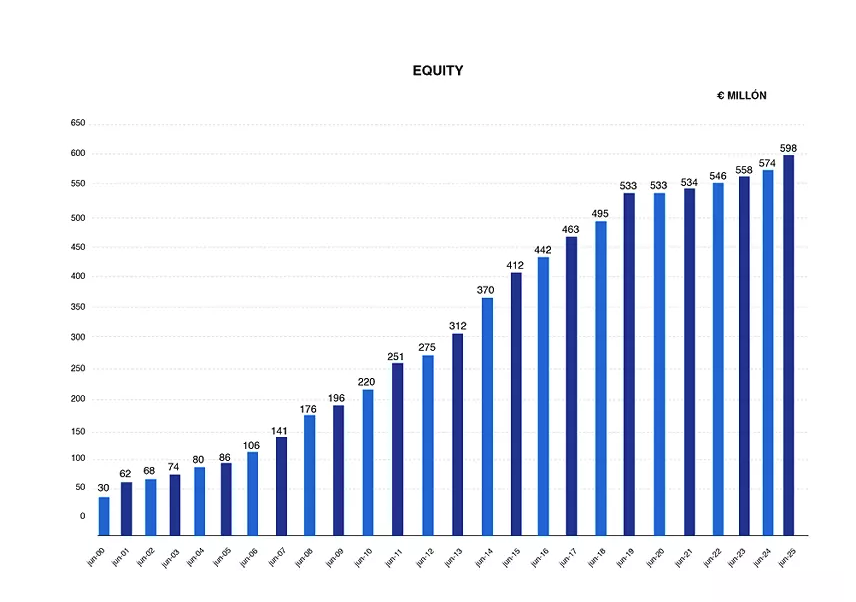
The club closed the financial year on June 30, 2025 with net equity of €598 million and a cash position of €166 million, double the €82 million held a year earlier. Real Madrid’s net debt, excluding the stadium loan, was just €12 million.
In total, the club has access to €425 million in undrawn credit facilities, reinforcing its ability to meet financial obligations while investing in squad development and infrastructure.
Stadium redevelopment nears completion
The club’s investment in the Santiago Bernabéu reached €1.347 billion. Principal repayments on the €1.17 billion loan began in 2023/24, with €23 million repaid during 2024/25.
Core structural elements, including the roof and retractable pitch, were completed by the end of the previous financial year. Business development works, such as hospitality areas, the stadium tour and events space, continued through 2024/25.
Once catering and concert infrastructure is finalised in 2025/26, the club expects a further uplift in stadium-related revenues. Notably, the club is preparing to host its first NFL fixture, a milestone for both Real Madrid and the Spanish capital’s global sports ambitions.
A financial model for the modern game
Real Madrid’s ability to post record financials during a period that included the tail-end of the pandemic and extensive capital investment underlines the club’s long-term approach to self-sustaining growth.
Its EBITDA margin improved to 18% (up from 13% in 2023/24), and the cost control ratio dropped to 43% – the lowest since 2000 and well beneath the 70% upper limit recommended by the European Club Association.
With €356 million contributed to tax and social security systems during the year, Real Madrid also reaffirmed its significant economic footprint beyond the pitch.