


Stage 11 in Bilbao ended without a winner and with a clear message to rights-holders: protest is no longer a rare-event outlier but an operational variable that needs resourcing, rehearsals and clear decision-rights.
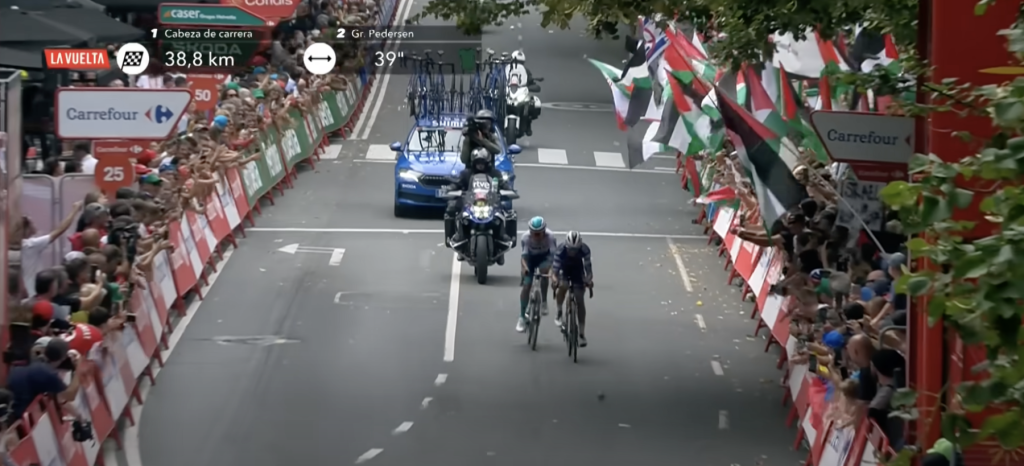
It started like countless finales in a grand tour city: barriers lined, flags waving, the soundscape tightening as the leaders approached the last kilometres.
Then the radios crackled.
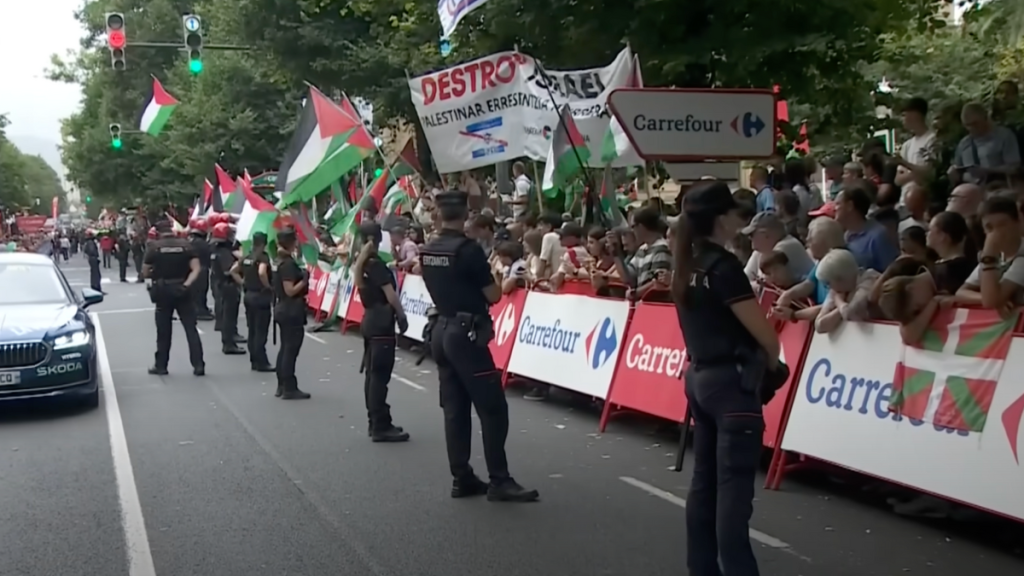
With demonstrators massed near the finish of Stage 11 of the 2025 La Vuelta, and security lines strained, race direction froze the general classification at the 3km banner and neutralised the stage. No winner was declared.
Riders Jonás Vingegaard and Tom Pidcock, who had prised open a gap on the final climb, rolled through to an unofficial finish and a night of what-ifs.
What actually happened — and who decided it
Organisers of the cycling race ended the Bilbao-to-Bilbao stage early on safety grounds after repeated protest interruptions along the route and a concentrated risk at the finish.
Under race-management discretion, GC times were taken at 3km to go and the podium ceremony was cancelled. The Professional Cyclists’ Association (CPA) had already pushed for tighter security following incidents earlier in the race.
The UCI later condemned the “actions that led to the neutralisation” in a statement, and restated its commitment to political neutrality, signalling institutional support for the organiser’s safety-first call.
“The UCI expresses its solidarity and support for the teams and their staff as well as the riders, who should be able to practise their profession and pursue their passion in optimal conditions of safety and serenity.” – UCI
Why this is an operations and governance story
Stage 11 was not an isolated flashpoint.
On Stage 5, protesters held up Israel–Premier Tech (IPT) during the team time trial; on Stage 10, Intermarché-Wanty’s Simone Petilli crashed amid a road incursion by demonstrators. That pattern forced a formal safety meeting before Stage 11 and sharpened the CPA’s stance that rider welfare was being compromised.
Race technical director Kiko García said publicly that organisers cannot expel a UCI-registered team and hinted that “only one solution” remained if security could not be guaranteed — a voluntary withdrawal by IPT — underlining both the limits of organiser authority and the pressure points in multi-stakeholder governance.
Commercial chain reaction
For broadcasters, a neutralised finale removes the narrative beat they have sold to viewers and sponsors. The post-race package shrinks, highlight reels lose a centrepiece and schedulers scramble to fill minutes that would have been devoted to a podium and interviews.
Contract language often treats neutralisation differently to full cancellation, so the question becomes whether the disruption meets a “material interruption” threshold that unlocks make-goods or additional shoulder programming.
Sponsors face a similar pivot. On-site activations and social content built around a winner evaporate in seconds, while brand-safety risk climbs when political protest becomes the dominant image on screen. The best prepared partners have contingency assets and community messaging ready to deploy, but many will still see a value haircut on the day.
Insurance sits behind all of this. Event cancellation or abandonment policies, and separate SRCC or terrorism extensions, determine how much of the lost value can be recovered when a stage is curtailed rather than called off.
And finally there is the team dimension. If one squad becomes a recurring flashpoint, organisers collide with a governance dilemma that pits equal participation against aggregate safety and continuity. As García’s remarks hinted, the conversation quickly moves from sport to policy.
How other sports managed protest disruption
Event owners have reached for four levers when politics or protest collide with competition: postpone, relocate, neutralise, or cancel.
Formula 1 chose the hardest option in 2011 and cancelled the Bahrain Grand Prix after unrest escalated, which forced broadcasters and sponsors to rewrite their early-season plans. La Liga took a different route in 2019, postponing El Clásico from October to December 18 once Catalonia protests swelled, and it kept the match in Barcelona but on a new date with a heavier security footprint.
Football’s South American showpiece shows how relocation can salvage a product when a host city cannot. CONMEBOL moved the 2019 Copa Libertadores final from Santiago to Lima, preserved the calendar, and delivered the broadcast with a new operational plan. Tennis opted for delay without a return date when the WTA postponed the 2019 Hong Kong Open indefinitely, prioritising player movement and venue access over calendar integrity.
Cycling and indoor sport offer clear examples of neutralisation and rapid reset. ASO halted and then neutralised Tour de France Stage 10 in 2022 after climate activists blocked the road, restarted the race, and compressed the finish to protect rider safety and broadcast flow.
At the 2023 World Snooker Championship, officials suspended play after a Just Stop Oil activist poured a packet of orange powder paint over a table, forcing a 24-hour suspension in the match between Robert Milkins and Joe Perry. Organisers re-clothed the affected table, and resumed the schedule later that session to meet ticketing and TV commitments.
Continental bodies have also adopted rolling relocation policies when a single territory remains volatile. UEFA barred Israeli clubs from hosting in Israel after October 2023 and shifted fixtures to neutral venues, while EuroLeague used a mix of postponements and relocations for Israeli teams across multiple seasons.
Each choice carried a distinct commercial outcome: cancellation triggered refunds and reputational cost, postponement created congestion and staffing strain, relocation preserved the event at higher logistics expense, and neutralisation protected safety while thinning the narrative that partners had planned to monetise.
La Vuelta now sits in that last category, and organisers can still escalate to relocation or postponement if they cannot guarantee a sterile finish zone in the days ahead.