



New research hints women’s sports should no longer just be concerned about exposure, and focus more on sustained value.
Women’s sport programming reached 48 million people in 2025 across UK broadcast platforms, rising from 45.2 million in 2024 and beating the previous record of 46.7 million in 2023, according to new data from the Women’s Sport Trust.
Published on February 11, the data saw football continue to lead the pack, accounting for 62% of all women’s sport consumption last year, with 74% of football viewing hours attributed to the UEFA Women’s Euros.
Rugby union emerged as the second most-watched women’s sport, growing to 18% of total viewing share, which was helped by the Rugby World Cup being broadcast free-to-air on the BBC.
Free-to-air coverage on international tournaments is the perfect combination for expanding audiences, helping push rugby union into the silver medal spot past cricket. However, industry stakeholders are questioning if this model is enough to progress, especially at the domestic level.
Women’s sports at an inflection point
While the focus so far has been on increasing exposure, Women’s Sport Trust CEO and Co-founder Tammy Parlour said the data suggests the sector is now entering a new phase.
“The data points to a sector at an inflection point,” she said. “Investment continues to grow. Platforms and formats are evolving. Audiences are present. For the more established properties, the challenge now is not necessarily more exposure, but smarter conversion: turning moments into habits, and visibility into sustained value.”
This is increasingly evident in football, particularly in the Women’s Super League (WSL), where the early focus on reach and accessibility is now giving way to commercial pressure to build more resilient revenue models.
The league’s partnership with YouTube during the 2024/25 season, which saw all 66 non-televised matches streamed free-to-air, led to viewing figures tripling.
However, as the WSL released its first full-year accounts since separating from the FA, the financial reality is hard to escape. Revenues rose to £17.4m, but the league posted an operating loss of £8.2m, a result it said was anticipated as it kept up distributions to clubs during its independence transition.
Surviving the switch
While exposure has helped build audiences, commercial sustainability increasingly pushes leagues towards premium distribution and monetisation models.
Disney+’s coverage of the UEFA Women’s Champions League (UWCL) attracted a younger, more female and more affluent audience than BBC broadcasts, with higher proportions of ABC1 viewers and under-35s.
The data from Women’s Sport Trust suggests subscription platforms provide improved revenue and also more commercially attractive audience profiles.
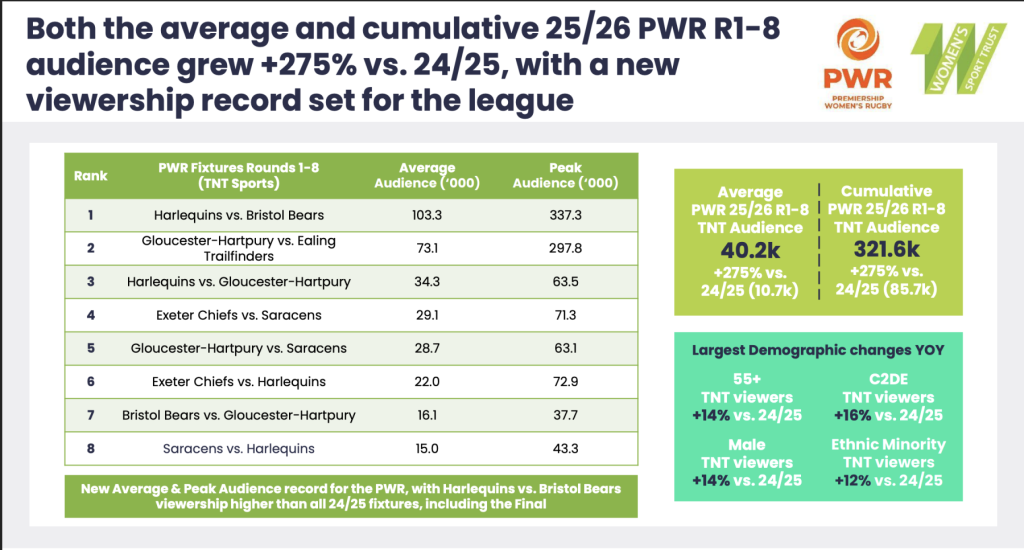
A similar pattern can also be seen in women’s rugby, as despite being a smaller market than football, the Premier Women’s Rugby (PWR) competition has seen growth on TNT Sports.
Average audiences across rounds one to eight of the 2025/26 season rose 275% year-on-year, while cumulative viewership also increased by 275%, with several fixtures setting new league records.
The TNT audience skewed older, more male and more working-class than previous seasons, showing paid platforms can also help unlock new demographics.
Meanwhile, broadcast data from the first 11 weeks of the 2025/26 WSL season shows that while Sky Sports audiences grew significantly following the league’s new rights deal, reduced BBC coverage led to declines in free-to-air reach and viewing hours.
Sky’s increased output drove a 30% rise in viewing hours and a 25% increase in average watch time, but BBC reach fell by 15% year-on-year.
“Major international tournaments once again demonstrated the power of shared moments, bringing new audiences into the system, elevating athletes, and pushing women’s sport further into the mainstream. But this data also shows that visibility alone is not enough,” said Parlour.
“Attention spikes quickly; retention is harder won. Where systems are aligned (across scheduling, platforms, storytelling and domestic opportunity) interest is more likely to stick. Where they aren’t, momentum fades.”