


Chelsea FC has broken an English football record, posting a £262.4m pre-tax loss for 2024/25. This is the highest deficit in Premier League history.
Chelsea FC has recorded the biggest pre-tax loss in Premier League history for the year ending June 2025, with a pre-tax loss of £262.4m ($346.3m).
This tops the previous highest pre-tax loss by £64.9m, when Manchester City FC posted losses of £197.5m for the 2010/11 season.
The news comes on the back of a record £10.75m fine issued by the Premier League, after the club self-reported financial breaches which occurred under the previous Roman Abramovich ownership.
Announced on April 1, Chelsea says its record loss was attributable, in part, to rising operating costs in 2024/25, driven predominantly by increased matchday costs as a result of a return to European football. Other Premier League clubs have faced similar matchday costs as a result of playing European football, with losses not reaching the level reported by Chelsea.
The club has opted to highlight its improved revenue for the calendar year, which rose to £490.9m, the second highest on record for Chelsea.
Chelsea: A previous profit built on exceptional items
The headline figures represent a swing of £390.8m in a single year – from a £128.4m profit in 2023-24 to a £262.4m loss in 2024-25.
The 2023/24 profit was not generated by the football operation itself, but by two intra-group asset sales: the transfer of Chelsea Football Club Women to Blueco Midco, a subsidiary of the parent company, for almost £200m, and a separate sale of hotel properties to a related entity in 2022-23 for £76.5m.
Strip those transactions out, and Chelsea’s underlying position in 2023-24 was already a significant loss. Speaking to Insider Sport, football finance expert Kieran Maguire explains how those deals shaped the profit and sustainability (PSR) rules at the time.

“Chelsea will be safe in terms of Premier League PSR compliance due to the sale of the Women’s team and real estate assets in 2023 and 2024. These sales generated £275m of profit and allowed Chelsea to absorb the record losses incurred in 2024/25 and still be within the PSR allowable loss of £105m over three years,” he says.
UEFA rules differ from the Premier League, however, and the European footballing body sanctioned Chelsea at the start of the 2025/26 season because internal real estate asset sales are not permitted under its rules.
“Chelsea were given sanctions by UEFA at the start of 2025/26 because no profits are allowed from such related party transactions, including both those mentioned above and player sales to MCO [multi-club ownership] clubs such as Strasbourg,” Maguire adds.
“The Premier League have tightened up the rules recently, effectively prohibiting, for PSR purposes, these Get Out of Jail transactions, but Chelsea should still be safe as the historic sales are not impacted by the new rules.”
The cost of the transfer strategy
The deeper structural driver of Chelsea’s losses is the unprecedented transfer activity since Todd Boehly and Clearlake Capital completed their £4.25bn takeover in May 2022.
The club has spent approximately £1.5bn on player acquisitions since then, heavily favouring young players signed to long-term contracts – a structure designed to spread amortisation costs across more accounting years.
According to UEFA, Chelsea’s playing squad carries a combined transfer value of approximately £1.47bn, making it the most expensive squad ever assembled globally.
In 2023-24, Chelsea’s amortisation charge alone stood at £190m – the highest in the Premier League — and is expected to have risen further in the 2024-25 accounts given the return to European football and continued squad investment.
Agent fees compound the picture
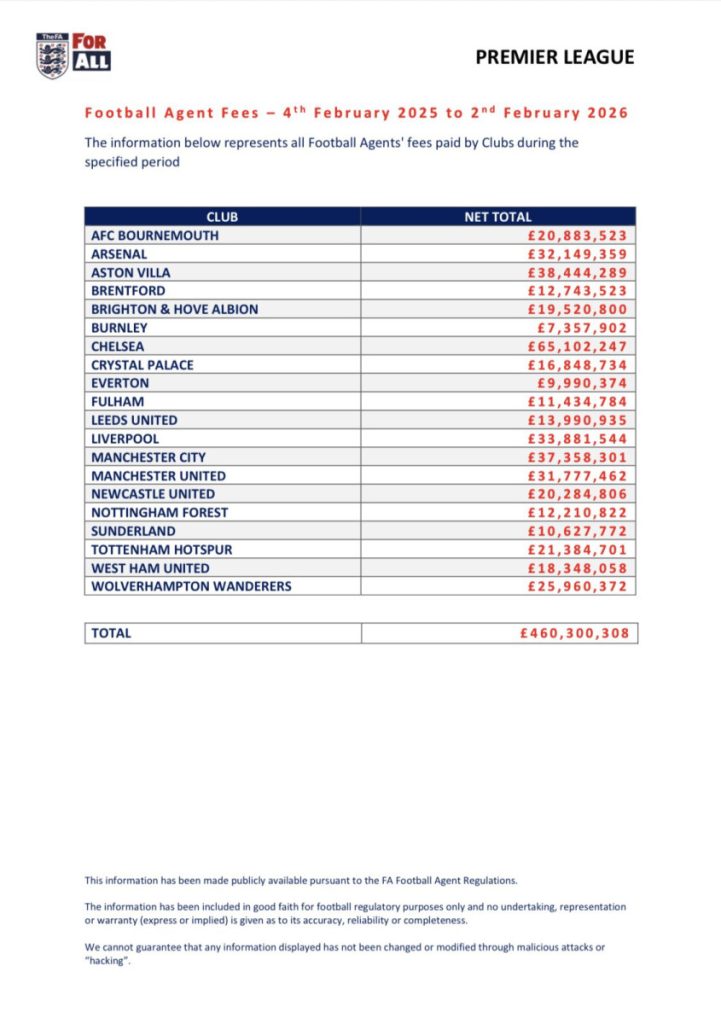
On the same day the accounts were published, the FA released its annual agent fees data covering February 2025 to February 2026.
Chelsea’s bill of £65.1m was the highest in English football – nearly £27m more than second-placed Aston Villa (£38.4m), and more than double the figures posted by Arsenal (£32.1m), Liverpool (£33.8m) and Manchester United (£31.7m).
Chelsea alone accounted for more than one in seven pounds of the £460.3m spent across the entire division. The club attributed part of the figure to fees arising on the selling side of its record Premier League sales in summer 2025 – selling clubs still pay agents on outgoing deals.
However, Chelsea’s agent fee bill has topped the Premier League for three consecutive years, reflecting the sheer volume of buying, selling, loan arrangements and contract updates conducted under the current ownership.
Notably, the FA data recorded a contract update for Mykhailo Mudryk during the period, despite the winger not having played since November 2024 following a doping charge. Agent fees are capitalised and folded into amortisation calculations, meaning they compound the long-term cost burden rather than sitting as a clean one-off charge.
Chelsea is projecting revenue of over £700m for 2025-26, driven by a return to the Champions League and full recognition of Club World Cup prize money.