




The UK horse racing industry has faced its fair share of challenges over the last few years – racecourse closures, governance changes and – most recently – an ongoing battle to engage new audiences.
This, unfortunately, isn’t a problem that has been limited to the UK market. Global racing bodies have been in search of new and innovative ways to introduce new demographics to the world of racing.
Racecourses play host to after-racing music concerts, discounted ticket prices on specific days and a growing shift towards digital campaigns in a bid to attract the more social-savvy Gen Z audience.
However, a new report commissioned by Spotlight Sports Group revealed the racing industry still has a long way to go when it comes to engaging a new global audience, which it estimates could be up to 200 million people.
The report, entitled ‘The Horse Racing Audience Opportunity’, included research from a range of racing stakeholders, including the Hong Kong Jockey Club, Ascot Racecourse, Horse Racing Ireland, the Japan Racing Association and the Victoria Racing Club in Australia.
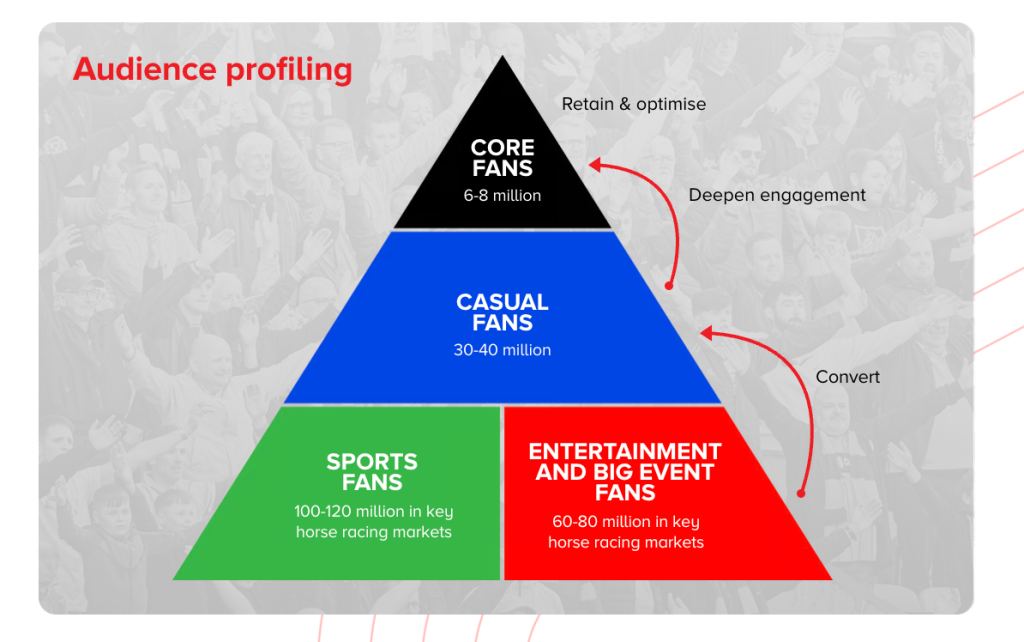
It estimates that the sport’s current global fanbase stands at between 36-48 million fans, which it has divided into two categories: core fans and casual fans.
Core fans are said to comprise 6-8 million people globally, 63% of which are men – although this number is much higher in the UK and Ireland, with 74% male fans compared to 26% women.
From a global socioeconomic perspective, 46.3% of those that fall into this demographic are classified as having a high income, and 31% on medium income.
Meanwhile casual fans, estimated to be 30-40 million people around the world, are split much more evenly between male and female fans; 44.3% are said to have a high income, with 28.9% on a medium income.
However, there are two additional segments of potential racing fans that aren’t currently accounted for: sports fans (100-120 million people globally) and entertainment & big event fans (60-80 million globally).
An untapped opportunity
The report by Spotlight Sports Group suggests that the racing industry has a great opportunity to tap into these additional demographic segments. It outlines three key steps to achieving this:
- Convert sports fans and entertainment / big event fans into casual racing fans
- Deepen the engagement of casual racing fans, thereby turning them into core racing fans
- Retain and optimise core racing fans
The report read: “There is enormous untapped potential for racing to grow its engaged customer base, principally by persuading general sports and big event fans to become racing fans. Moreover, if racing succeeds in that ambition, it will almost inevitably attract new and younger demographics.
“Sports fans tend to be known as sports fans for a reason. Just as followers of racing will generally also enjoy other sports, it is invariably the case that those who are fans of football have wider sporting interests.
“There is natural crossover between football, cricket, rugby union and rugby league, darts and snooker. There is no reason why racing could not become one of the go-to sports for those sports fans who currently consciously or unconsciously ignore it.”
The report also highlighted that the way in which audiences are consuming sports is continuing to evolve, particularly with the rise of social media and growing adoption of smartphones.
It showed that 85.9% of racing fans defined themselves as being ‘mobile first’, while 70% of sports fans aged between 18-44 admitted to following teams or athletes on social media.
To racing’s likely dismay, only 19% of the UK audience surveyed said that ‘only the big events are worth watching’, highlighting that the sport is continuing to struggle converting casual racegoers to long-term racing fans.
“Older generations are relatively more likely to be fans of racing, but less likely to identify as general sports fans. It would, however, be dangerous to believe that what has tended to happen in the past will continue to prove true in the future,” the report continued.
“Racing cannot merely assume that as young people develop wrinkles they will somehow become attracted to sprint handicaps and staying chases. If racing is to prove popular with a meaningful number of the 16 to 44 year olds previously identified as representing key target groups, it needs to adapt its offering.”
So how can racing respond?
The question of falling engagement doesn’t look like it’s going away any time soon. With the rising cost-of-living impacting how fans consume sports content, racing now finds itself at a critical crossroads to ensure its own survival.
Of course, the attempt to attract casual fans to the local racecourse with side events has provided an uptick in interest. But with a potential 200 million global fans that are being missed, there is a huge opportunity here for racing.
One of the suggestions outlined in the report is that racing needs to reposition itself – moving away from being a betting product, and instead focusing more on its history, heritage and excitement around the sport. This, the report suggests, will be vital in attracting the widest possible audience.
There is also a suggestion that the horse racing industry can learn a lot from the exponential growth of interest in Formula 1 – a sport that has undergone significant transformation under the ownership of Liberty Media.
Liberty Media has centralised digital rights and created unified, narrative-led content to ensure consistency across markets, ultimately creating a single fan-facing digital ecosystem owned by the rights holder. This has undoubtedly had an enormous impact on how fans engage with the sport.
The sport’s global fanbase grew from 500 million in 2017 – the year Liberty Media completed its takeover of F1 – to 830 million in 2025. With the horse racing industry embattled by fragmented rights, accounts, content and no unified platform, it makes it much more difficult for new fans to engage with the sport.
However, arguably the most vital consideration that racing must make is ensuring that its target audiences actually understand the sport and the significance of particular race types.
Sam Houlding, Managing Director B2B at Spotlight Sports Group, said: “Racing has a product problem that isn’t really about the product. The challenge is that for too many potential fans, it arrives without context. They don’t know why a race matters, who they should care about, or where it sits in any broader story.
“The sport has extraordinary raw material, and that’s where we come in. We’re content specialists, and we’re finding new ways to tell racing’s stories on the platforms where new audiences actually live.
“The bigger opportunity is to connect the sport’s major events into a season-long narrative, even a linked global series that fans can follow from one meeting to the next. Give casual fans a storyline they can get behind long before they ever open a racecard, and you’ve changed the relationship with the sport entirely.”
The report concludes by warning that racing can no longer afford to take an inactive approach to fan engagement – especially if it wants to survive into tomorrow.
Racing looks like it has a long road ahead, and many uphill battles to get younger audiences interested in the sport. But if it looks to emulate the successes seen in sports like Formula One, or perhaps even Darts, it could be on to a winner.