

















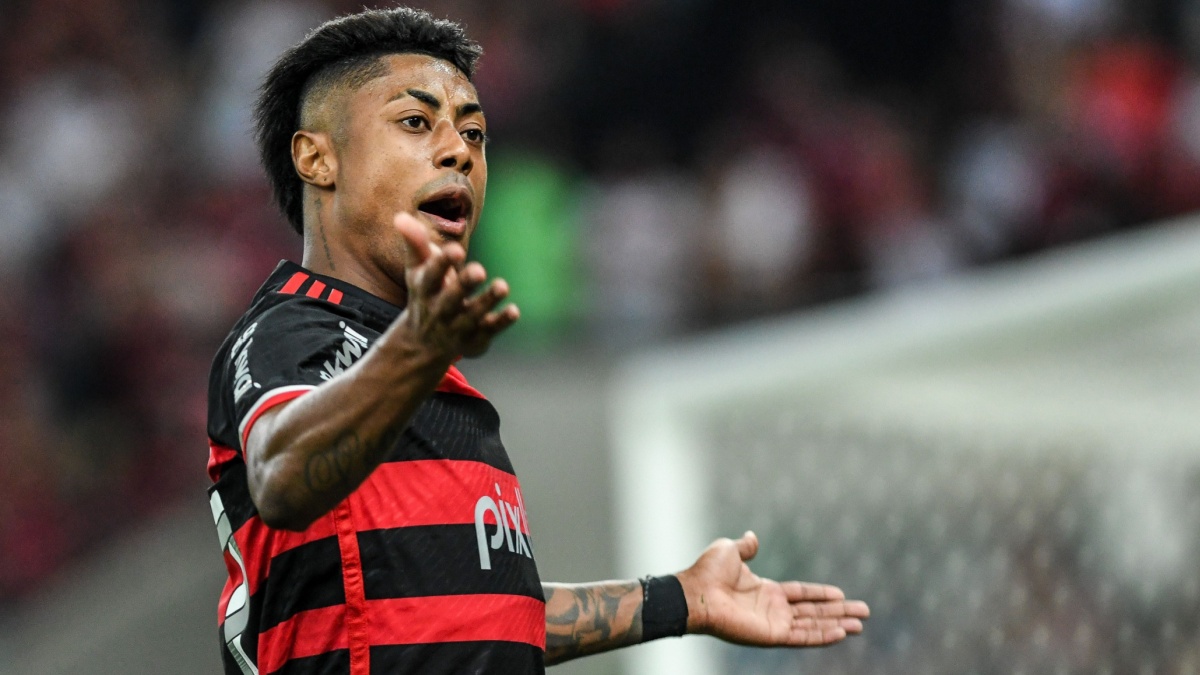
Bruno Henrique still plays for Flamengo despite match-fixing charges, while others like Alef Manga faced swift bans. Riccardo Assis examines how status shapes justice in Brazilian football.
Bruno Henrique became the subject of a federal match-fixing investigation in November 2024, a year after receiving a yellow card in a match against Santos in the 31st round of the Brazilian Championship.
On November 5, 2024, Brazil’s Federal Police launched the “spot-fixing” operation, targeting the Flamengo striker, along with his family and friends. In June 2025, Henrique was officially charged by the Public Prosecutor’s Office of the Federal District for alleged involvement in a match-fixing and fraud scheme targeting betting companies.
Despite the charges, as of August 2025, Henrique continues to play for Flamengo.
His case stands in contrast to that of Alef Manga. The striker received a yellow card in a September 2022 match against América-MG and was later implicated in a separate match-fixing investigation. In August 2023, Brazil’s Sports Court (STJD) suspended him for 360 days. He returned to the pitch in October 2024 and now plays for Avaí in the second division.
There are key differences between the two cases. Henrique allegedly did not receive money directly, instead helping third parties. Manga, on the other hand, is accused of accepting around $8,031 (R$ 45,000) to deliberately get booked, according to the investigation.
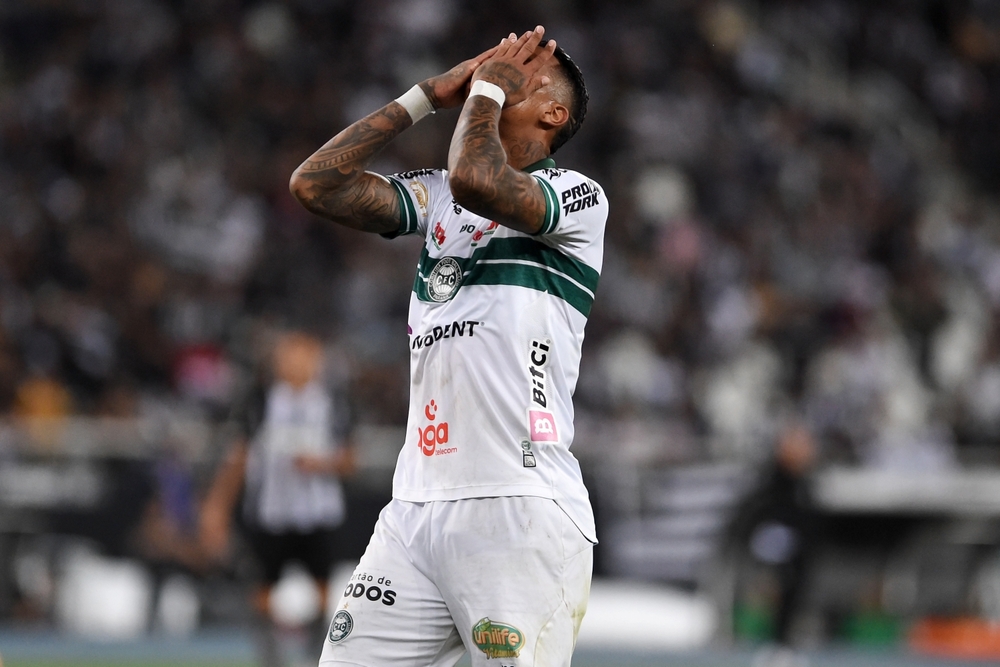
But what stands out is how differently the two players were treated. Coritiba quickly dropped Manga from the squad after charges emerged. Flamengo defended Henrique, citing the “presumption of innocence” in an official statement. The legal processes have moved at different speeds as well. Manga was suspended within a month of being charged. Henrique, by contrast, has faced no suspension, with the STJD stating it will not request a provisional ban.
Henrique’s status adds another layer. A fan favourite, he signed a contract extension in late 2024, reportedly earning around R$ 1.9 million per month.
Why risk so much for so little?
Cases like this raise questions about player awareness of the law, blurred definitions of match-fixing, and the pedestal on which high-profile athletes are often placed. The distance between star players and everyday consequences can distort judgment.
Manga and others caught in Operation Penalidade Máxima never enjoyed the same earnings or protection. Gabriel Tota, banned by the STJD (with the decision upheld by FIFA), told Globo Esporte he had “never seen so much money” as the R$ 110,000 he was promised for recruiting players from Juventude.
For a 22-year-old like Tota, the temptation proved career-ending. Henrique, meanwhile, continues playing despite his alleged role in a criminal scheme.
Both Manga and Henrique were found to have exchanged dozens of messages with third parties, openly discussing how to get booked. The difference lies in the structure behind the cases: a criminal network in Manga’s, and more peripheral involvement, allegedly, in Henrique’s.
Mitigating factors matter. Unlike Henrique, Manga and Tota operated in precarious financial conditions. In Brazil’s lower leagues, late or unpaid salaries are common. For these players, match-fixing sometimes appears to be the only route to financial stability.
The justice system rarely accounts for that context. Lower-league players are easier to prosecute given their lack of visibility, influence, and legal support. Meanwhile, star players earning millions benefit from delay, ambiguity, and PR protection.
These cases reflect a deeper truth: in Brazilian football, how match-fixing is handled still depends on whose name is on the back of the shirt.