



The WRU’s consultation puts the women’s game at the heart of reform, committing to two fully professional teams, a new domestic league and stronger pathways under one coherent performance system.
The Welsh Rugby Union has launched a formal consultation on a radical restructure of elite rugby that puts a two-club model at its core.
The blueprint would concentrate men’s and women’s talent into two fully funded professional clubs, add a national performance campus, and align contracting and pathways under one system. A Board decision is targeted for the end of October 2025.
The consultation focuses on elite rugby only – national teams, professional teams, academies and pathway structures – with the community game and schools’ rugby out of scope. Stakeholders include the four men’s professional clubs, PRB, WRPA, players, supporters’ groups and URC representatives, alongside a wider engagement with fans and partners.
“We are clear that the current rugby model in Wales is no longer delivering what our game needs,” says WRU CEO Abi Tierney.
“This consultation is about listening. No decisions have been made, and it’s crucial that we work together. Every voice matters, including, critically, our professional clubs, and everyone must have a seat at the table to help shape the future of rugby in Wales.”
The WRU’s “proposed optimal system” comprises five linked elements: two clubs each running a men’s and a women’s team; unified rugby leadership and contracting; a new national performance campus; a revised funding model; and enhanced pathways including a strengthened Super Rygbi Cymru and a new domestic women’s competition.
Why change, and why now?
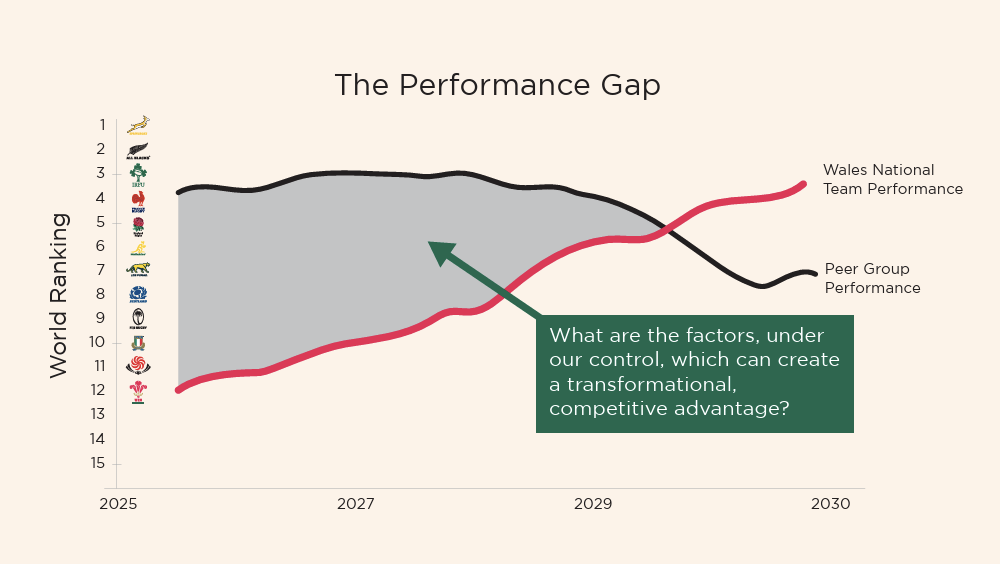
Wales’s professional game is being asked to do too much with too little. The WRU’s own analysis says the four men’s clubs “are not funded at a level where the men’s teams can compete,” while the women’s pathway still needs fully fledged professional teams to match ambition.
This funding gap shows up in the numbers with club overheads outpacing organic revenues since FY19. Without WRU or owner cash, the regions are “not viable businesses.”
On the field, the player base is also stretched. Wales has more pro clubs relative to its participation base than peer nations, which dilutes squad quality and cohesion across teams. The system also leans heavily on non-Welsh-qualified players – 27 senior NWQPs at a cost of ~£3.8m in 2024–25 – further limiting minutes and investment for Welsh talent.
Governance is compounding the problem. The WRU says current “PRA style arrangements are a particularly challenging choice due to an inherent misalignment between stakeholder objectives,” creating bureaucracy and friction in key decisions (selection, injury management, player development).
This misalignment has spilled into the open. In May 2025 the union moved away from equal funding after not all clubs signed the new agreement, a shift Reuters reported as the trigger for unequal distributions and a formal two-year notice on the old deal. Internally, the WRU board also concluded on May 13 that the One Wales plan to fund four men’s clubs equally was “no longer viable” given performance and financial headwinds.
There’s a contrasting story in the women’s game: demand is surging (a 21,186 record crowd for Wales v England on 29 March 2025), yet the domestic structure still lacks a like-for-like, semi-pro bridge to the elite.
“There is no women’s equivalent to the SRC,” the document notes. That’s why the consultation ties growth to creating two fully professional women’s teams and a domestic league alongside academies and a national campus.
The models on the table
Four men’s structures are being tested:
- Four clubs, unequal funding;
- Three clubs, equal funding;
- Three clubs, unequal funding; and
- Two clubs, equal funding.
Current analysis indicates Model D best supports performance and financial sustainability, subject to consultation.
Under Model D, each club would run a 45-player senior men’s squad and 20 male academy players, with squad budgets at £8.0m and coaching/back-room set at £2.1m. Over five years, WRU funding for men’s clubs would total about £94m, private investors £17m.
Crucially, this option is the only one that frees significant reinvestment, around £25m over five years, into academies, pathways, facilities and the women’s game.
By comparison, three-club scenarios envisage £6.9m squad budgets and higher total WRU outlay, while four clubs with unequal funding push more cost and risk back onto the system. The Board has already concluded that the current four-club equal funding model is no longer viable.
“This is a genuine consultation process and while we have our own ideas based on the research we have done, we know the best solutions come from listening,” says WRU Director of Rugby & Elite Performance Dave Reddin.
“The approach we have designed is respectful, thorough, and inclusive and we encourage people to challenge our ideas and help us create something that we can all get behind.”
National campus and aligned leadership
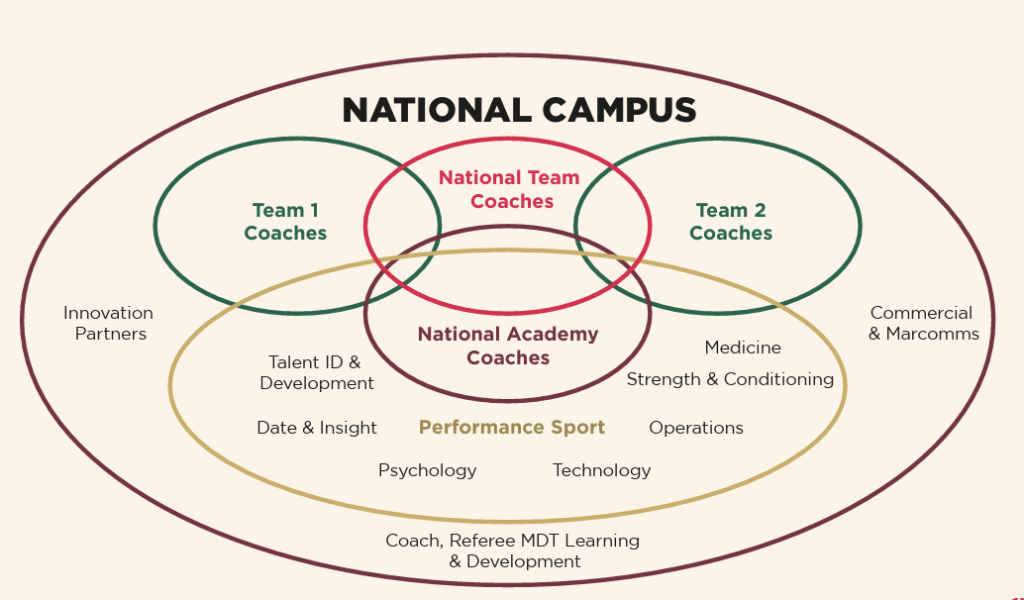
A cornerstone of the plan is a single performance campus bringing together national teams, the two pro clubs, national academies and shared services such as S&C, medical, data and innovation.
The WRU positions the campus as a generational investment designed to “supercharge collaboration” and attract partners. Contracting and rugby operations would be unified to reduce friction and improve cohesion.
Pathways and the women’s game
Savings from consolidation would be used to deepen the men’s pathway, notably by enhancing Super Rygbi Cymru with higher standards, better staffing and increased profile, and by expanding Player Development Centres.
The women’s pathway would be accelerated via a new domestic competition and embedded professional teams within the two-club structure.
The modelling also suggests that, with tighter limits on non-Welsh qualified players, reducing the number of clubs can increase matchday opportunities per Welsh player across URC and Europe. The WRU highlights current spend and roster slots on NWQPs as a drag on both investment and local opportunity.
Consultation materials will be available in August, with a public survey running in September. The Board is seeking evidence-based feedback before making a decision at the end of October 2025.