



















Germany has beaten bids from Denmark and Sweden’s joint project and Poland to secure UEFA Women’s EURO 2029, setting up a third home edition for the tournament and another major commercial platform for the women’s game across eight high-capacity venues.
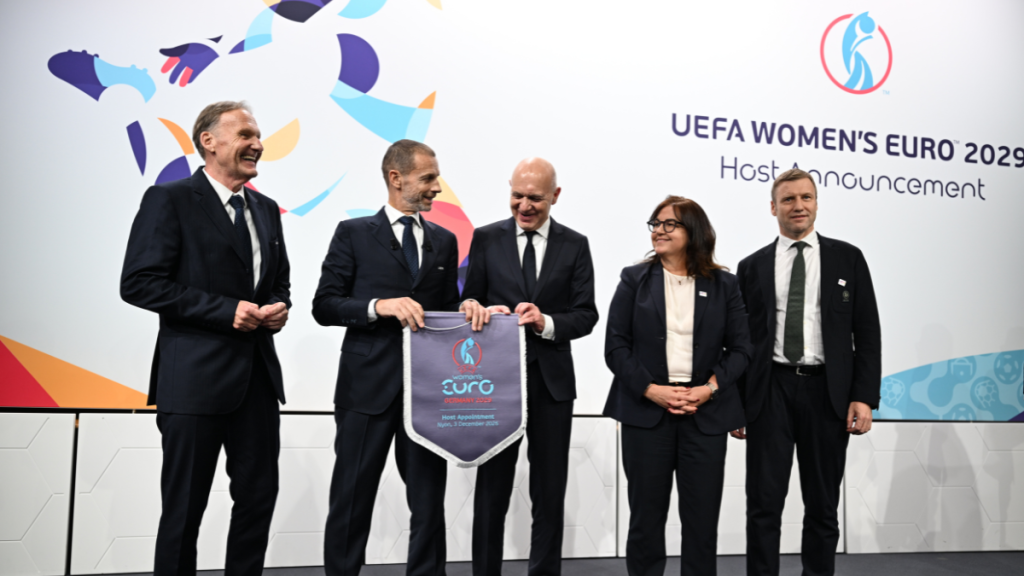
Germany will host UEFA Women’s EURO 2029 after winning a vote of the UEFA Executive Committee at the House of European Football in Nyon, securing 15 of 17 votes ahead of a joint Denmark and Sweden bid and a rival proposal from Poland.
The decision, announced on December 3, means Germany will stage the Women’s European Championship for a third time after previous editions in 1989 and 2001, and follows the country’s role as host of the FIFA Women’s World Cup in 2011 and UEFA EURO 2024 for the men’s game.
The 16 team tournament will be played in eight cities in the summer of 2029: Cologne, Dortmund, Düsseldorf, Frankfurt, Hanover, Leipzig, Munich and Wolfsburg. All are existing stadiums that already stage top-flight men’s football and most recently contributed to the EURO 2024 hosting model.
UEFA has confirmed that the Allianz Arena in Munich, branded as the Munich Football Arena for UEFA competitions, is part of the venue line-up and is expected to host the final, with Dortmund tipped for the opening match.
For Bayern’s home ground it is another addition to a packed portfolio of major events, including matches at the 2006 FIFA World Cup, the 2012 and 2025 UEFA Champions League finals, games at EURO 2020 and EURO 2024, and the UEFA Nations League finals in 2025.
These choices underline UEFA’s focus on high capacity venues. The majority of the stadia can host more than 45,000 spectators, significantly above the 18,000 crowd that watched Germany win the last Women’s EURO on home soil in 2001.
UEFA and DFB set expectations high
UEFA president Aleksander Čeferin used the announcement to praise all three bids and frame the 2029 tournament as a continuation of the recent growth of the competition following the record breaking Women’s EURO 2025 in Switzerland.
DFB president Bernd Neuendorf said Germany aimed to “set new standards” after Switzerland 2025, with the federation targeting more than one million fans across the tournament and referencing an ambition to make the event a commercial success.
Reports around the bid have also highlighted Germany’s goal for the event to become the first Women’s EURO to turn a financial profit, backed by a ticketing strategy based on larger venues in football strongholds such as Munich and Dortmund.
Nadine Kessler, UEFA’s director for women’s football, pointed to the competition’s trajectory as one of the world’s largest sports events and said Germany had “everything it takes” to build on the record attendances and global television audiences seen in Switzerland.
Legacy play for infrastructure and women’s football
Germany has grown the Frauen-Bundesliga’s profile and recently set a new national record for a women’s club game when more than 57,000 fans watched Bayern München defeat Bayer Leverkusen at the Allianz Arena.
The 2029 tournament provides an additional shop window for the league and its club sponsors, as well as a platform for new partners aligned to women’s sport and equality narratives.
Regional politicians have already begun to frame the event in strategic terms. North Rhine-Westphalia minister president Hendrik Wüst described the tournament as a “stroke of luck” for the state, highlighting the inclusion of Dortmund, Düsseldorf and Cologne and suggesting it could strengthen future bids for Olympic and Paralympic events by showcasing infrastructure and operational capability.
Winning out in a competitive bidding field
Germany’s success came after a competitive process that initially attracted interest from five potential bids. Italy and Portugal were among the early contenders before withdrawing, with Italy focusing on preparations for co-hosting EURO 2032 and Portugal prioritising its role in the 2030 FIFA World Cup project.
The final vote went decisively in Germany’s favour. UEFA confirmed that an absolute majority was required in the first round and that Germany collected 15 votes, with Denmark and Sweden receiving two and Poland none.
For the joint Scandinavian bid and Poland, the result raises questions about how UEFA currently weighs factors such as existing infrastructure, projected ticketing revenue, and risk allocation between tournament organisers and public authorities.
Youth tournaments round out UEFA calendar
The same Executive Committee meeting also awarded hosting rights for several youth competitions, filling in more of UEFA’s medium term calendar for women’s and men’s age group events. Belgium and Türkiye will host the UEFA European Women’s Under 17 finals in 2028 and 2029 respectively, while Portugal and Italy have been awarded the Women’s Under 19 tournaments in 2028 and 2029.
Lithuania and Moldova will stage the Men’s Under 17 championships in 2028 and 2029, with Czechia, Bulgaria and the Netherlands hosting the Men’s Under 19 editions from 2027 to 2029.