



What began as an effort to commercialise track‑and‑field has instead collapsed spectacularly, with GST now owing many athletes hundreds of thousands of dollars.
A court filing has revealed Grand Slam Track (GST) owes just under $10m to its top 20 creditors after filing for bankruptcy last week.
The track league, led by four-time US Olympic champion Michael Johnson, had described itself as “the global home of professional track”. Its inaugural season began in April 2025, although only three of the four planned meets took place.
Events were held in Kingston, Miami and Philadelphia, while the Los Angeles final was cancelled.
A selling point of the league was its promise to make track and field more entertaining and fan focused, built around star athletes and significant financial incentives for appearances and race wins.
However, according to an Official Form 204 filing made on December 15, many of those payments remain outstanding. Seven of the top 20 creditors are athletes.
Sydney McLaughlin Levrone is owed $356,250, Gabby Thomas $249,375, Kenny Bednarek $225,000, Josh Kerr $218,750, Marileidy Paulino $211,875, Alison dos Santos $190,625 and Melissa Jefferson Wooden $190,625.
The sums owed relate to a mix of prize money and appearance fees, though it remains unclear whether these figures include appearance fees for a cancelled Los Angeles event, which GST had previously said it would honour.
The largest creditor is broadcast production company Momentum CHP Partnership, which is owed $3.35m. Other large creditors include PMY Group for technology and live events services at $1.26m, and Girraphic for broadcast graphics at $690,624.

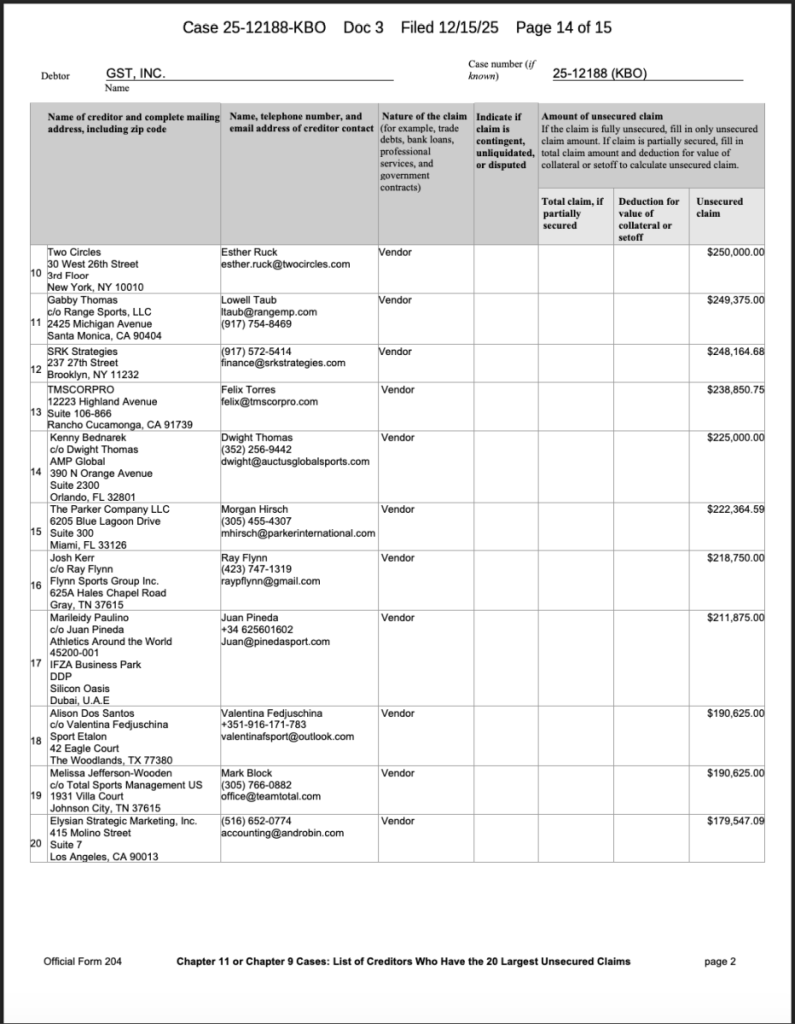
According to the filing notes there could be between 200 and 999 creditors, with overall liabilities estimated between $10-$50m.
The story of Grand Slam Track
GST was founded in 2024 by Johnson with the goal of reinventing professional track and field. The league promised to modernise the sport’s commercial model and claimed to have secured more than $30m in financial commitments at launch. The announcement generated significant interest, particularly among athletes frustrated by limited earning opportunities within traditional athletics.
The league’s opening meet in Jamaica’s capital Kingston, reportedly suffered from poor attendance, raising early concerns about demand. Events in Miami and Philadelphia followed, although the Philadelphia meet was shortened from three days to two because of operational challenges.
In April 2025, the league’s financial position deteriorated when a key investor unexpectedly pulled out. Johnson later described the withdrawal as creating a “major, major cash flow issue”, leaving GST struggling to meet its obligations.
The planned season finale in Los Angeles was cancelled and the league began falling behind on payments to athletes and vendors. Over the summer and into autumn, reports emerged athletes were owed six figure sums and that suppliers remained unpaid.
GST attempted to negotiate with creditors, offering to repay 50% of outstanding amounts, but the proposal was rejected.
On December 11 2025, GST filed for Chapter 11 bankruptcy protection in Delaware.
The current state of athletics
Athletics is going through a challenging period of reform, with new organisations like GST attempting to push the sport toward a more commercial future, similar to models seen in other major sports.
Athletes have been receptive to these ideas, largely due to track and field being widely known for offering relatively low financial rewards. Another organisation promising change is the Enhanced Games.
The Olympic style event, scheduled to launch its inaugural season next year, has drawn attention for its controversial approach of allowing athletes to use performance enhancing drugs.
Olympic athletes have already signed up, with swimmer Ben Proud becoming the first British athlete to join Enhanced Games in September alongside American sprinter Fred Kerley
Speaking to Insider Sport earlier this year, founder Aron D’Souza said: “The average US Olympian only earns $30,000 a year and that’s really unfortunate,” comparing this with the high earnings seen in leagues such as the NBA or the Premier League.
“It’s okay if the head of UEFA or FIFA has a private jet because Ronaldo has one,” D’Souza said. “But I think it’s intrinsically wrong that sports bureaucrats in the Olympic system are better paid than the athletes. The athletes are the core value creators.
“Athletes in our system get paid more than me. I’m proud of that. I want our athletes to be rich.”
All eyes will now be on whether the Enhanced Games can successfully launch and sustain operations, something GST was ultimately unable to achieve.
The organisation believes its business model gives it a stronger chance, with plans to generate revenue not only from broadcasting, sponsorship and merchandise, but also through pharmaceutical companies to commercialise performance enhancing drugs used by athletes.