



From 43 million viewers in France to 90% market share moments in Norway, early data from Milano Cortina 2026 suggests a significant uplift in reach across Europe during the Winter Games’ return to broader free-to-air distribution.
The opening week of Milano Cortina 2026 has already supplied the usual mix of elite performance and unplanned drama.
An athlete’s live television confession ricocheted across social media. Lindsey Vonn’s crash briefly quietened the slopes. And figure skating’s self-styled “quad god”, Ilia Malinin, left without individual gold despite attempting to stretch the sport’s technical frontier.
The question for rights holders is whether such moments translate into sustained reach. The early figures suggest they have.
The first week of the 2026 Winter Olympic Games has delivered heavyweight audience figures across Europe, with European Broadcasting Union (EBU) members reporting multi-million peaks, record digital consumption, and notable gains on Beijing 2022.
In France, 43 million viewers have watched at least one minute of coverage on France Télévisions during the opening phase of Milano Cortina 2026. That figure is 10 million higher than at the same stage of both Beijing 2022 and PyeongChang 2018, and represents the highest level recorded since 2006.
Average viewing time has also doubled compared with six days into Beijing 2022, with French viewers consuming more than three hours of coverage on average.
The uplift is mirrored digitally. The broadcaster’s streaming platform, france.tv, has generated 21 million video views already — surpassing the total recorded across the entirety of both the 2018 and 2022 Winter Games.
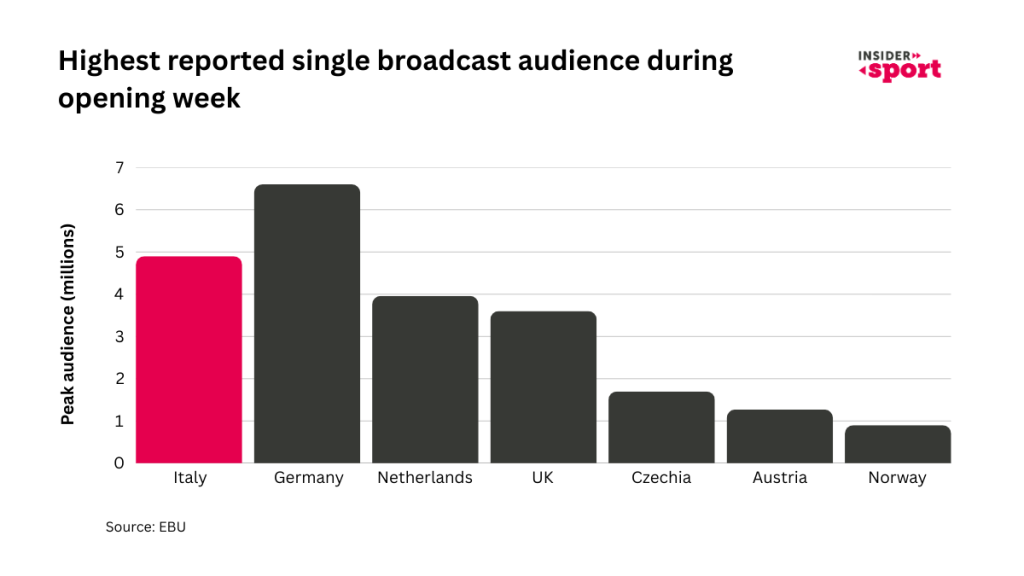
Meanwhile, host nation interest has translated into peak linear numbers. Italy’s RAI recorded a 4.9 million peak audience for early alpine skiing coverage as Sofia Goggia secured bronze in the women’s downhill. The equivalent event during Beijing 2022 drew just 712,000 viewers, underlining the scale of the host-nation multiplier when combined with free-to-air availability.
A structural shift in distribution
Milano Cortina 2026 marks the first Winter Games under a renewed agreement between the European Broadcasting Union and the International Olympic Committee following the 2018–2024 cycle, during which pan-European rights were held by Warner Bros. Discovery.
The new structure restores free-to-air prominence in key markets while maintaining a broader European partnership that spans both public service and pay platforms.
Early indicators suggest that the re-expanded free-to-air footprint is translating into higher penetration, stronger market shares and deeper digital engagement, particularly in markets where Olympic coverage had been absent from public broadcasters for more than a decade.
Northern Europe delivers market share dominance
In Scandinavia, reach and market share figures suggest exceptional concentration of attention. In Sweden, SVT has achieved a cross-platform reach of six million viewers as of 10 February – approximately 60% of the national population. The mixed curling final, featuring gold medal-winning siblings, attracted around three million viewers.
In Norway, where winter sport is deeply embedded in national identity, NRK reports total viewership of just under 5.4 million across NRK1, representing a 44% increase compared with Beijing 2022. Peak events including the biathlon mixed relay and men’s 20km skiathlon reached 899,000 viewers, each delivering a 90% market share.
Austria has produced similarly concentrated viewing. ORF recorded a 69% market share and peak audience of 1.27 million for the women’s downhill, the most-watched women’s Olympic downhill in the country since 2010.
Germany: scale and scheduling muscle
Germany’s dual-broadcaster model continues to provide scale. ARD and ZDF are delivering more than 200 hours of live coverage across their main linear channels, supported by roughly 700 hours each of digital livestream content.
ZDF’s live broadcasts are averaging 3.3 million viewers with a 25.3% market share. Peak performances include 6.6 million viewers for luge and 6.5 million for the biathlon mixed relay, the latter achieving a 45.3% market share.
Notably, Olympic luge coverage on Das Erste attracted 1.6 million more viewers than the DFB-Pokal match between Bayern Munich and RB Leipzig that followed — a rare instance of Winter Olympic sport outperforming domestic elite football in Germany.
UK performance led by digital engagement
In the UK, the BBC reports that more than 20 million viewers have tuned in to television coverage to date, with peak audiences reaching 3.6 million.
Digital and social engagement is also substantia with the BBC stating its Olympic content has generated more than 100 million social media views, while 17 million users have visited the dedicated Winter Games page on BBC Sport.
Meanwhile, Finland’s Yle reports that cumulative television reach has already climbed to 3.78 million people in a country of 5.6 million. Finland’s first men’s ice hockey match reached 2.2 million viewers, while digital platforms generated 267 million minutes of consumption during the opening phase, including nearly 55 million minutes on a single day.
In Switzerland, public broadcasters RTS, RSI and SRF recorded combined average audiences of over one million viewers for both the men’s and women’s downhill races. Across the first six days, more than 3.4 million people were reached via Winter Olympic television coverage.
Czechia has also seen record-setting performances, with Česká televize reporting 1.7 million viewers for the mixed biathlon relay — surpassing the previous Olympic record of 1.25 million set during PyeongChang 2018. Overall viewing is reported to have tripled compared with Beijing 2022.