


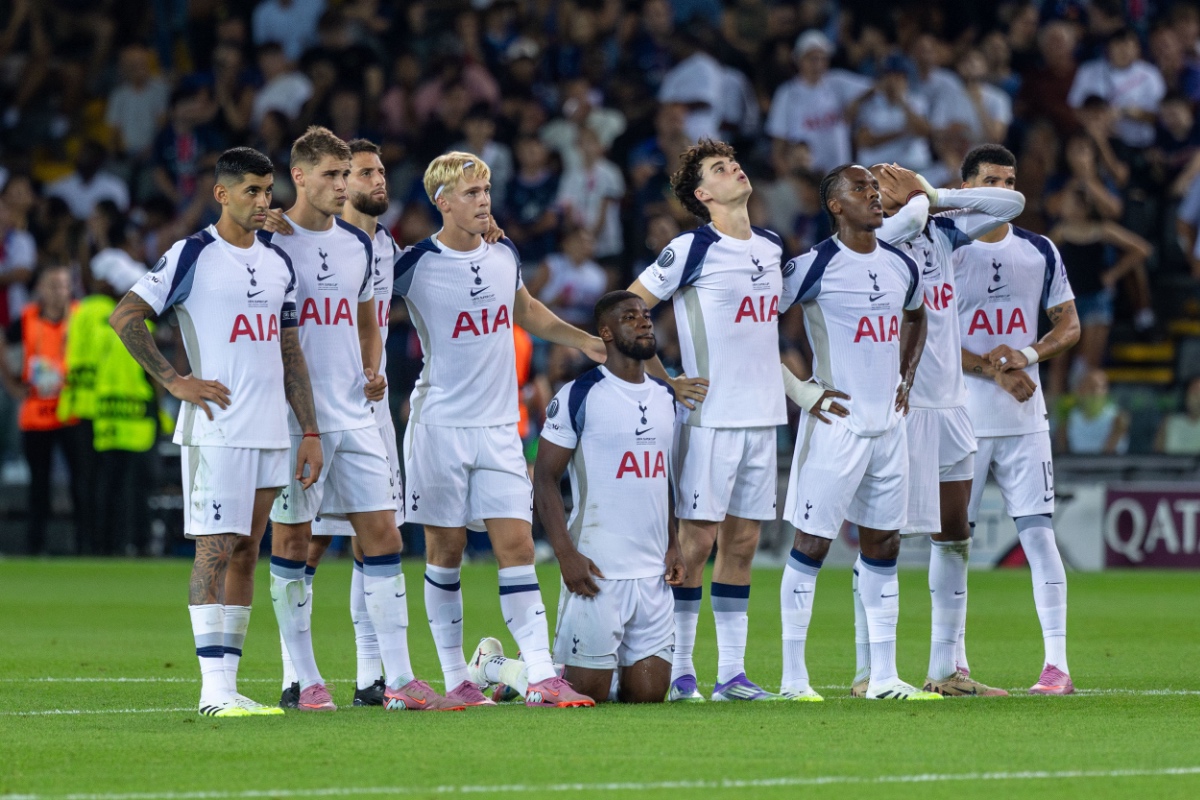
The upcoming North London derby between Tottenham and Arsenal is pivotal at both ends of the Premier League table, but for Spurs, it could be the difference between survival and relegation.
As Tottenham Hotspur prepare to face its North London rivals Arsenal on 22 February 22, the result could impact its ability to remain in the Premier League.
With Spurs currently five points from the relegation zone, the club is also facing pressure off the field as a club sponsor has revealed it will be severing ties at the end of the 2025/26 season.
Due to contract confidentiality, the sponsor cannot be named at this time, but has reportedly provided Tottenham tens of millions of pounds in recent years.
In an article published on 19 February by The Telegraph, it was revealed that the sponsor is ceasing the partnership, whether the club is relegated from the Premier League or remains next season.
Reportedly, the sponsor has been unsatisfied with the club’s focus on the Europa League, which it won in 2025; Tottenham finished 17th in the Premier League during the same season, its worst performance since 1997, which saw the club relegated to Division Two that year.
According to sources close to the matter, the sponsor values Premier League success more than the Europa League due to the English top-flight’s mass global audience, deeming a 17th position unacceptable.
“There has been no explanation from the club or acknowledgement of the domestic performance concerns from the club,” the source told The Telegraph. “Instead, their messaging was focused on the Europa League, which is not the tier of competition global sponsors expect from a so-called ‘elite club’.”
The club currently has 28 partners according to its website. Its two most prominent sponsors, front-of-shirt sponsor AIA and kit manufacturer Nike, have deals in place until 2032 – the front-of-shirt agreement ending at the end of the 2026/27 season – and 2033, respectively, for long-term financial security.
Recent official sponsorships, such as BetMGM, Kraken and Alipay, all have multi-year deals in place, although the agreement with Alipay expires at the end of the 2026/27 season. Other high-profile commercial partners include: Getir, HSBC, Schneider Electric, Hewlitt Packard Enterprises, Kumho Tire, Monster Energy, and Heineken.
Commercial sponsorships was Tottenham’s highest revenue-driver for its 2024 financial year results. These sponsorships brought in £255.2m for the year ending 30 June, 2024.
Could more sponsors follow suit?
With one Tottenham sponsor walking away from their agreement at the end of the season, will Spurs’ continued poor performances on the field cause more to follow suit?
Companies/businesses cancelling sponsorships over underperformance on the field is not uncommon in football. Adidas, who had sponsored Liverpool since 1985, opted not to renew its kit manufacturer deal in 2012 after the club had failed to qualify for the Champions League in three consecutive seasons.
Tottenham’s Premier League performances continued to translate into this season, sitting 16th in the table and recently sacking Manager Thomas Frank with Igor Tudor brought in to replace him on an interim basis.
If performances continue to underperform and the possibility of relegation becomes a realisation, Tottenham sponsors coming to the end of their contract this season could follow the unmanned sponsor’s decision.
The club is also in the midst of uncertainty regarding its ownership group, with interest from a consortium regarding former Chief Executive Daniel Levy’s 30% in ENIC, the majority shareholder of Spurs.
After nearly 25 years in his position, Levy’s departure from the club in September 2025 also brought uncertainty over the direction of the club.
The financial impact of relegation
Not only could a loss in commercial revenue become a financial issue for Tottenham if they were to be relegated from the Premier League, this would be the least of its concerns regarding revenue.
The club received £165.9m in TV and media, primarily from the Premier League’s prior broadcast rights deal, both domestic and international. In the 2024/25 season, despite finishing 17th, Tottenham received £127.8m in broadcast revenue from the Premier League.
As the new four-year, £6.5bn domestic broadcast rights deal starts this season (2025/26), clubs like Tottenham are expecting to have broadcast revenue from the league increase again.
This is why relegation can have a major financial impact on clubs dropping down to the EFL Championship, the loss of the lucrative Premier League broadcast rights revenue.
Leicester City may serve as a precautionary tale for Spurs. Having won the Premier League in 2016 and the FA Cup in 2021, Leicester’s poor performances in the Premier League following saw the club relegated twice in 2022/23 and 2024/25.
The Foxes’ broadcast revenue it received in its last spell in the Premier League in 2024/25 was £116.9m. In the previous season (2023/24) Championship, Leicester’s broadcast revenue was £54.2m, a 63% difference.
Player salary
Once a team is relegated from the Premier League, some of the club’s better players naturally seek moves away from the club to remain competing at top-flight levels.
Leicester sold James Maddison to Tottenham when the club was relegated in 2023, while Manchester City bought Nathan Ake from Bournemouth in 2020, both for fees around £40m.
Player sales, particularly a relegated club’s best player, immediately become an important source of funds to handle the financial pressures of not accumulating either broadcast or new sponsorship money away from the Premier League.
But if relegated clubs are unable to offload players on high salaries, this can also become a financial burden. Some players may also be unwilling to move from a relegated club if they will be earning more salary at that club, as opposed to a club in the Premier League but on a lower salary.
Immediate promotion is not a guarantee
While parachute payments are designed to help guide relegated clubs’ sustainability efforts, this does not immediately translate into success and subsequent promotion back to the Premier League.
Having spent 10 seasons in the Premier League, Stoke City have yet to earn promotion back from the Championship. Wigan Athletic spent eight years in the Premier League before being relegated in 2013, even slipping further down the football pyramid to EFL League One in 2023.
A lack of investment and results on the pitch ultimately play a factor in a club’s chances of earning promotion, which is why it may prove more difficult for relegated clubs competing against Championship clubs with fresh investment.
Ryan Reynolds and Rob McElhenney have engineered Wrexham’s ascent to the Championship over the past several years through investment. Tom Brady and Knighthead Capital have also invested heavily in bringing Birmingham City back to the Premier League for the first time since 2011.