













The pioneers of women’s rugby faced the Netherlands without the Gallic rooster on their shirts. More than 40 years on, that has finally changed
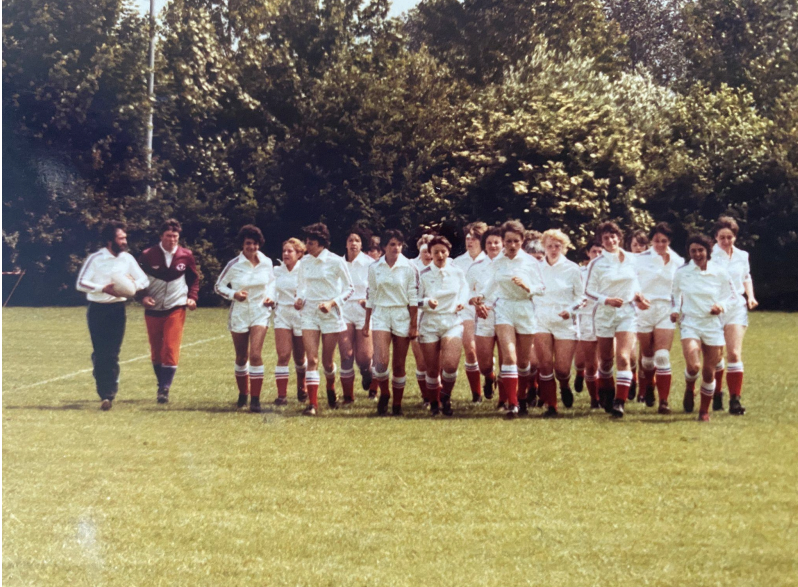
On 13 June 1982, 22 French women boarded a bus in Chilly-Mazarin, drove 500 kilometres (310 miles) to Utrecht, and played the Netherlands in what is now recognised as the first official women’s international rugby match.
France won 4–0. They sang La Marseillaise before kick-off, but they did not wear the Gallic rooster.
Worn by every French national team for more than a century, the Gallic rooster emblem was withheld from the squad because women’s rugby sat outside the French Rugby Federation‘s (FFR) jurisdiction.
The players competed under the Association Française de Rugby Féminin, a separate body, and so were handed a tricolour badge in place of the rooster that defined the national side.
When Monique Fraysse – who played centre in Utrecht alongside her twin sister Nicole – spoke to World Rugby about the 1982 match, she was unambiguous about what that missing emblem meant to the players.
“We were not allowed to wear the rooster because we were a women’s federation.”
Today (April 11), in Grenoble, ahead of France’s Women’s Six Nations fixture against Italy, the FFR formally recognised the 1982 squad as France internationals for the first time.
A ceremony 44 years in the making
Members of the 1982 squad returned to the pitch alongside the current French women’s team, lining up together to sing La Marseillaise.
Earlier in the day, the players were presented with their international cards, officially recognising their status as France internationals for the first time.
The FFR only took formal responsibility for women’s rugby in 1989, and caps were not retrospectively granted for matches played before that year. For the founding generation of French women’s rugby, decades of history existed without official acknowledgement.
“Wearing this jersey today is something we never imagined,” said former player Véronique Champeil. “To finally be recognised as internationals… it’s something we struggle to put into words. We’ve seen this jersey for years – and now it’s ours.”
The 1982 squad had not even been awarded caps for their appearance in Utrecht. The FFR only took formal responsibility for women’s rugby in 1989, and caps were not retrospectively granted for matches played before that year.
Growing the game, honouring its roots
The initiative was led by Renault in partnership with the FFR. Florian Grill, President of the French Rugby Federation, framed the recognition in the context of a sport that has grown almost unrecognisably since 1982 – when there was not a single women’s club in England outside university rugby, and the concept of a professional women’s game was decades away.
“The exponential growth of women’s rugby today must never let us forget those who paved the way,” said Grill.
“Together with Renault, we are proud to honour these pioneering women, thanks to whom 55,000 registered players can now fully live out their passion. Times have finally changed: today, women players proudly wear the rooster on their shirts, letting it shine and putting France in the spotlight.”

Growth in the women’s game has been well documented; last year’s Women’s Rugby World Cup in England drew record audiences.
Tammy Parlour, CEO of the Women’s Sport Trust, tells Insider Sport: “This moment is a powerful illustration of how much women’s rugby has evolved, and how quickly that change is continuing. It’s not just about celebrating progress, but recognising the generations who helped build the foundations for the visibility the sport is experiencing today.
“Our latest visibility research shows that 2025 delivered record audiences and visibility for women’s sport, with the Rugby World Cup driving a significant surge, and competitions like the Women’s Six Nations continuing to attract substantial audiences.
“That growing attention is helping to strengthen the connection between the international stage and the wider women’s game. The next step is making sure that visibility isn’t just concentrated around major events, but continues to build more consistently across the season.”