



Canadian regulator has reaffirmed OneSoccer’s Canadian ownership and ruled that Rogers Communications gave the channel an undue disadvantage by refusing to carry it.
The Canadian Radio-television and Telecommunications Commission (CRTC) has ruled that OneSoccer continues to be owned and controlled by a Canadian entity, ending a challenge by Rogers Communications that sought to invalidate an earlier finding of unfair treatment.
The decision strengthens the position of independent sports broadcasters in a market long dominated by vertically integrated giants.
OneSoccer, operated by Timeless Inc., holds exclusive rights to Canadian Premier League (CPL), CONCACAF competitions and national team football matches. Yet the channel has faced an uphill battle gaining carriage on major cable platforms.
The most notable instance has been with Rogers, which owns competing properties including the Sportsnet network.
The long-running dispute escalated after Timeless filed a complaint in 2022, accusing Rogers of giving its own networks undue preference and subjecting OneSoccer to disadvantage by refusing to carry it. In a March 2023 decision, the CRTC agreed and directed both parties to propose remedies.
But Rogers challenged the legitimacy of that ruling, arguing that OneSoccer was effectively controlled not by Timeless, but by Mediapro – a non-Canadian production company that had been involved in the service’s day-to-day operations.
Rogers contended that if OneSoccer was not truly Canadian, it would be ineligible for CRTC protections and not entitled to file the original complaint.
The Commission has now rejected that argument in its Broadcasting Decision CRTC 2025-187, stating that Timeless retained strategic and operational control of OneSoccer throughout the relevant period, even while contracting production to Mediapro. The ruling notes that Mediapro’s role ended in December 2024, and that production has since shifted to MidPro, a Canadian company.
“Timeless has retained the ongoing ability to determine the strategic decision-making activities of OneSoccer,” the Commission wrote. “Production and technical services… on their own do not grant control to the party providing them.”
With the regulatory question settled, the Commission has instructed both Rogers and Timeless to submit updated remedies by August 11. These could include commercial terms, arbitration procedures, or mandatory carriage agreements to ensure OneSoccer is treated equitably.
Final replies are due by August 18, with Timeless also required to submit the full MidPro contract by August 27.
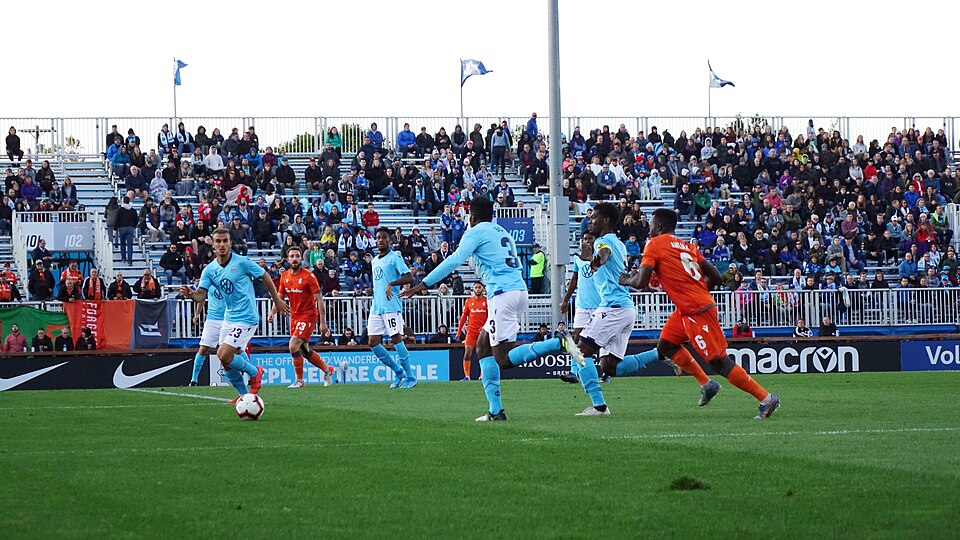
Canadian Premier League (CPL) soccer match between HFX Wanderers FC (blue kits) and Forge FC (orange kits) at Wanderers Grounds on September 18, 2019, in Halifax, Nova Scotia, Canada. Source: HFX Wanderers FC vs. Forge FC
Market implications
The CRTC’s firm stance reasserts the principle that Canadian ownership must be respected, but also that contracting with international production partners does not invalidate local control. This is a critical clarification for smaller broadcasters and streaming ventures.
It also highlights the commercial and regulatory tensions that arise when distributors are also broadcasters. Rogers’ refusal to carry OneSoccer while prioritising its own networks exemplifies the challenges facing independent rights holders trying to reach national audiences. The Commission’s decision underscores that vertical integration cannot justify anti-competitive carriage practices.
If OneSoccer secures broader distribution as a result, it could mark a turning point for the visibility and growth of Canadian football. The CPL, still a relatively young league, relies on access to mainstream platforms to drive attendance, sponsorship, and commercial interest. Regulatory intervention may prove essential in levelling the playing field.
A precedent for challenger networks
While the dispute centres on a Canadian football channel, the broader precedent may resonate across sports verticals. Challenger broadcasters- whether focused on women’s sport, regional leagues or underserved fanbases – often face structural barriers to distribution in markets dominated by a handful of powerful media groups.
This decision shows that such platforms have tools at their disposal to assert their rights, not just through commercial negotiation, but through regulatory enforcement. The CRTC’s willingness to validate a complaint, investigate ownership, and impose timelines for remedies could signal a more assertive role in maintaining competitive balance within Canada’s sports media landscape.