Last week’s splashy indictments made for gripping copy. But an industry study shows the real integrity risk lies outside the regulated system
When federal agents marched NBA names into the glare last week, it played like a morality tale for opening week: a head coach, a starting guard, and a web of illegal betting and rigged poker rooms with mob ties.
Court papers and briefings sketched two overlapping schemes, one around high-tech underground poker and another exploiting insider knowledge for prop bets; Portland’s Chauncey Billups and Miami’s Terry Rozier drew the loudest headlines.
“For years, these individuals allegedly hosted illegal poker games where they used sophisticated technology and enlisted current and former NBA players to cheat people out of millions of dollars,” stated NYPD Commissioner Jessica Tisch. “This complex scheme was so far reaching that it included members from four of the organized crime families, and when people refused to pay because they were cheated, these defendants did what organized crime has always done: they used threats, intimidation, and violence.”
Federal filings in the Eastern District of New York describe 30-plus defendants across the cases and detail cheating tech from “X-ray” tables to rigged shufflers, along with an alleged insider-betting plot tied to specific NBA games in 2023–24. The league placed those implicated on leave pending proceedings.
Then over the weekend I read an article in The Atlantic where Sally Jenkins argued the indictments are “not what they seem” and went so far as to suggested the government oversold the significance. Whether you agree or not, the piece usefully reframes the question: what’s the scale of the integrity risk we should actually be worried about?
A report published by the American Gaming Association in August 2025 offers a sobering answer. In 2025, Americans are estimated to wager $673.6bn each year with illegal and unregulated gambling operators, generating $53.9bn in revenue for those operators and depriving states of $15.3bn in tax receipts.
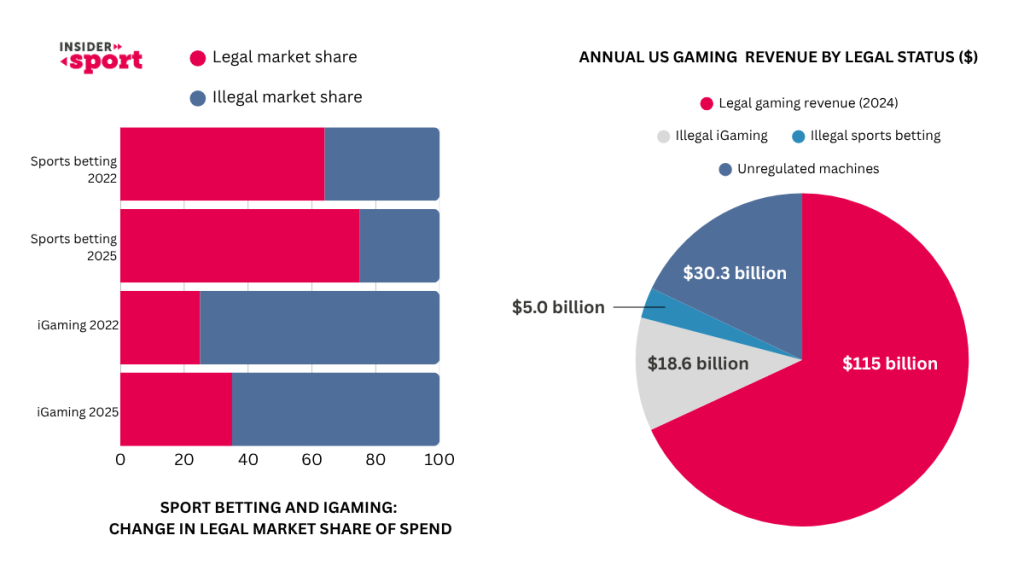
Within that, illegal sports betting accounts for $84bn in handle and $5bn in revenue; illegal online slots and table games (iGaming) dwarf that at $466.2bn in handle and $18.6bn in revenue; and an estimated 625,000+ unregulated “skill” machines take in more than $123bn in wagers for about $30.3bn in revenue.
No one can argue these are back-alley operations.
Since 2022, illegal sportsbooks’ share of US activity has fallen from 36% to 24% even as their absolute revenue rose to around $5bn. The legal market’s scale and monitoring tools are clearly pulling bettors onshore. That aligns with what NBA Commissioner Adam Silver has suggested before – that integrity detection improves inside regulated markets, much as insider trading is policed in public markets.
But “less bad” isn’t “safe”. Prop-bet incentives remain a pressure point—one player, one market, one tip can move money.
Meanwhile, the illegal iGaming market still captures about 66% of total US online casino activity, down from 75% in 2022 but still dominant. Furthermore, unregulated machines – often sitting in bars and gas stations – are estimated at roughly 40% of all gaming devices in the US, with weaker consumer protections and clear money-laundering vulnerabilities.
If you’re serious about sports integrity, you can’t ignore the wider criminal infrastructure that illegal iGaming and machines sustain.
The point is not that last week’s arrests do not matter. They do, because they expose how easily individual-performance markets can be gamed and how underground gambling ecosystems intersect with mainstream sport. But the scale problem sits elsewhere.
The data shows an illegal market that still outmuscles enforcement and distorts incentives. If sport wants fewer scandals, regulators and operators need to make the illegal supply chain more expensive to run than the legal one is to use. That means coordinated action on payments and domains, clearer consumer signposting, and a narrower, better-governed set of prop markets in season.