



Lower-tier competitions and globally fragmented markets continue to account for a significant share of integrity risks, according to the latest data from the IBIA.
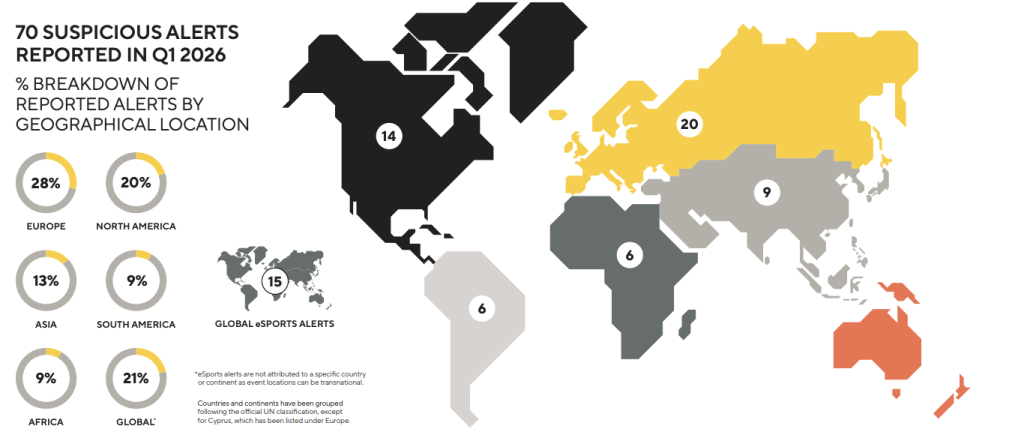
Integrity risks in global sport continue to concentrate in lower-tier competitions and fragmented betting markets, as the International Betting Integrity Association (IBIA) reported 70 suspicious betting alerts in the first quarter of 2026.
The alerts, spanning 10 sports, were shared with relevant regulators and governing bodies, with football once again accounting for the largest proportion of cases.
According to the report, football generated 25 alerts, representing 36% of the total, while tennis (16 alerts) and esports (15 alerts) were the next most affected sports. Together, the three accounted for more than 80% of all flagged activity.
However, the report also points to a recurring integrity concern beyond headline numbers. Several alerts in tennis and table tennis were linked to events outside recognised professional tours or international federation structures, reinforcing concerns around the monitoring of lower-tier competitions.
IBIA noted that all seven table tennis alerts in the quarter related to matches outside International Table Tennis Federation (ITTF) competitions, while six tennis alerts were tied to events beyond the main professional circuits.
Geographic spread remains fragmented
From a regional perspective, Europe accounted for the largest share of alerts at 28%, followed by North America (20%) and Asia (13%). Africa and South America each represented 9% of reported cases, while esports alerts were categorised as global due to their cross-border nature.
At a country level, Mexico was the most frequently flagged jurisdiction for football-related alerts, with eight cases recorded, while activity was also identified across markets including Brazil, Cyprus, Albania and Ghana.
The distribution reflects the global nature of betting markets, where liquidity and access often extend beyond domestic regulatory frameworks.
Brazil highlights regulatory shift
The report also places particular focus on Brazil, where the introduction of a federal licensing regime in 2025 is expected to reshape the structure of the betting market.
IBIA data shows that 68 suspicious alerts were recorded in Brazil between 2021 and 2025, the majority linked to football. Over the same period, the market has transitioned from largely offshore activity towards a regulated onshore model.
Forecasts cited in the report suggest Brazil’s sports betting gross gambling revenue could reach BRL 28.8bn by 2030, with more than 80% of activity expected to take place within the licensed market.
Across Latin America more broadly, Brazil is projected to account for 39% of total betting revenue in 2026, ahead of Mexico (21%) and Argentina (13%), underlining its growing influence in the regional market.
IBIA’s monitoring network continues to expand, with the association overseeing more than 1.5 million sporting events annually across over 80 sports and analysing betting activity tied to more than $300bn in global turnover.
The association’s membership now includes more than 90 companies and over 200 betting brands, with its integrity services operating across multiple regulated jurisdictions, including parts of Europe, North America and Brazil.