


Real Madrid is preparing to open its doors to outside investors for the first time in its history, as Florentino Pérez pairs announcement with criticism of UEFA and LaLiga.
Real Madrid‘s president has confirmed plans to allow external investment into the club for the first time in its 123-year history, while maintaining full control under its 100,000 members.
At the club’s 2025 Ordinary General Assembly on November 23, President Florentino Pérez announced a new subsidiary company will be created, with governance remaining in the hands of the membership and a minority stake believed to be between 5-10% reserved for one or more long-term strategic investors.
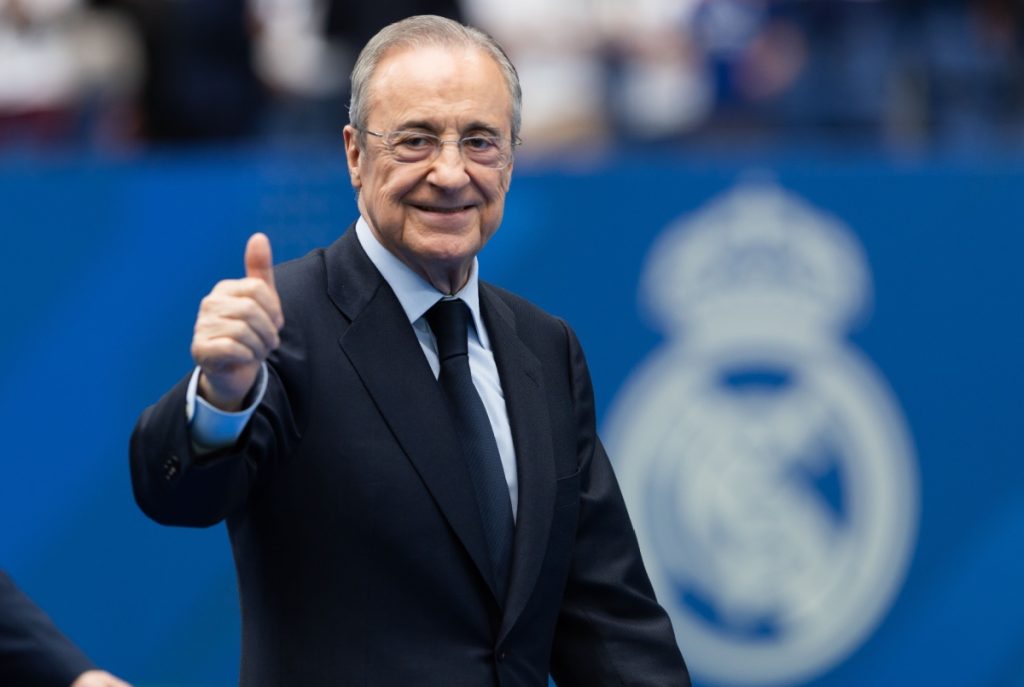
Under the proposal, members would continue to elect the president and board of directors, retain voting rights on major statutes, and hold membership shares which can only be passed to their children or grandchildren. Investors would be entitled to financial returns but granted no decision-making powers, ensuring the club’s historic socios model remains intact.
The socios structure, in place since Real Madrid’s founding in 1902, means the club is owned collectively by its members rather than private shareholders. It centres around Spanish football’s “club of the people” tradition, shared by Barcelona, Athletic Bilbao and Osasuna, where fans serve as the custodians.
Speaking at the assembly, Pérez said the reform aims to “make visible the value of Real Madrid” while providing tangible benefits to members, who would gain financial rights that do not currently exist. He argued the change would help protect the club’s assets from external threats and bolster its standing as a global commercial powerhouse.
The reform will require approval via a referendum of all voting members aged 18 and over, with the vote expected to be scheduled for early 2026.
Perez doesn’t hold back
While the assembly spoke briefly about Madrid’s newly proposed governance model, Pérez also used the platform to deliver one of his most sweeping and detailed attacks on football’s wider leadership in years, criticising UEFA, LaLiga and their presidents.
He accused UEFA of abusing its dominant market position in European football, citing the Madrid Provincial Court’s ruling earlier this month, which addressed 21 points in the European Super League case and sided with the Super League’s backers on all of them.
The court found UEFA and FIFA had abused their position by threatening sanctions against participating clubs and reinforced earlier conclusions that the project could not be blocked outright under competition law.
Pérez argues the judgement confirms clubs have the right to organise alternative competitions and said UEFA’s expanded formats for the Champions League and Europa League “detract from the spectacle and harm fans” by prioritising institutional control over sporting merit and fan experience.
Revealing the next phase of Madrid’s legal strategy, he confirmed the club has begun seeking financial damages from UEFA for obstructing the Super League’s launch, a project he called “indispensable” for closing the revenue gap with the Premier League.
Javier Tebas responds
After attacking European governance, Pérez turned his focus to domestic issues and LaLiga president Javier Tebas.
He began by condemning the plan to stage a league fixture in Miami, arguing it would distort the competition by stripping Barcelona of an away match. The FC Barcelona vs Villarreal fixture, scheduled for December 2025, was ‘reluctantly’ approved by UEFA, but LaLiga ultimately scrapped the plan after pushback from players, supporters and several clubs.
Tebas was a vocal supporter of the match and speaking at Sportel Monaco in October, expressed frustration that the approval process had been stalled. He described UEFA’s retreat as an “old-fashioned vision of professional football”, insisting that exporting “just one game, not twenty” was a natural step for the league.
Pérez’s criticism did not stop at the Miami controversy, as he went on to accuse LaLiga of mishandling the Negreira refereeing scandal and argued it was “not normal” for the league’s executives to earn higher salaries than their Premier League counterparts despite generating far less revenue.
He singled out Tebas directly, recalling when the LaLiga chief took office in 2013 he reduced his salary to €348,000, calling his predecessor’s €395,000 pay “excessive”. “It turns out,” Pérez said, “that Mr. Tebas has increased his salary more than tenfold, at the expense of clubs who have to sell players to survive.”
Tebas responded hours later with a statement on X, saying he felt “sadness” at being portrayed as an enemy of the club he grew up supporting.
He rejected accusations of being anti-Madrid, insisting he had been a Real Madrid fan since childhood and “being a Madridista isn’t given to you by a piece of paper, a vote in an assembly or a seat in the box”. He argued defending a strong, competitive LaLiga was, in his view, also defending Real Madrid, because “without a solid league, Real Madrid itself will also be smaller.”
He criticised what he called the club leadership’s pursuit of “megaprojects of competitions that weaken and destroy the home that helped them become great”, adding those who run Real Madrid today are “not the club, nor its history”.
While some members reportedly called for him to be declared persona non grata, Tebas said no label or vote could “erase what I’ve felt since I was six years old”, concluding defending LaLiga is, “in my own way, defending Real Madrid.”