


La Liga secures €6.135bn in domestic broadcast rights, as it looks to close the revenue gap on the Premier League.
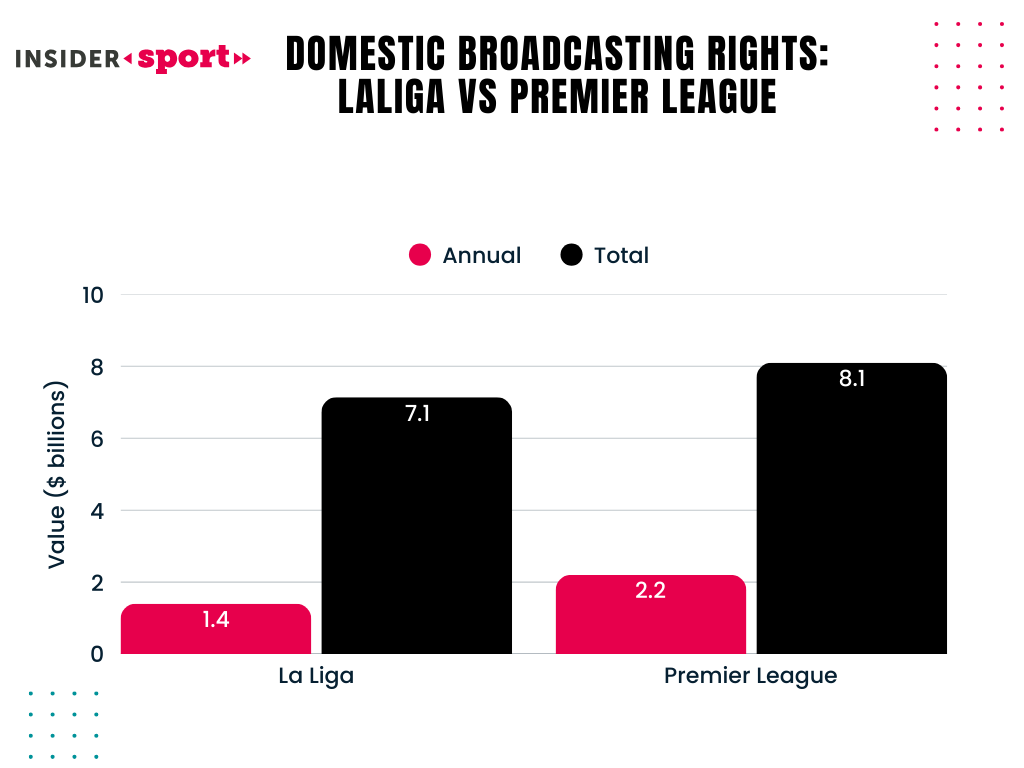
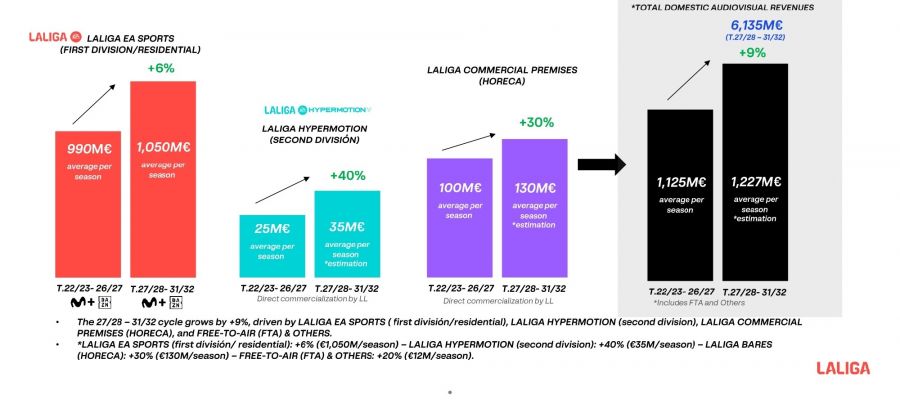
La Liga has announced it has secured over €6.135bn ($7.146bn) in domestic broadcast rights for the 2027/28 to 2031/32 cycle.
As part of the new deal, Telefónica and DAZN will remain La Liga’s primary domestic broadcasters, each holding rights to air five matches per matchday across the next five seasons. The arrangement also sees the league continue its hybrid broadcast model for a consecutive cycle, first introduced in the previous rights period.
Looking at the numbers, first division residential rights account for €5.25bn, a 6% rise on the 2022–2027 cycle, while revenues from commercial premises such as bars and restaurants are up 30% and expected to reach €650m.
La Liga HYPERMOTION second division rights have also increased by 40% to €175m, with free-to-air and highlights contributing a further €60m.
“In today’s complex domestic and international landscape, securing over €6.135bn in domestic rights and an overall growth of 9%, equivalent to more than €500m over the previous cycle, is excellent news for the financial sustainability of our Clubs and the future of Spanish professional football,” said Javier Tebas, President of La Liga.
“At a time when many leagues are experiencing declining media values, La Liga’s continued growth and record highs are especially significant. This result reflects the strength of our product and the trust of broadcasters, largely driven by our committed fight against piracy, which has helped increase operators’ user bases, and by the Clubs’ dedication to enhancing audiovisual content and offering the best possible fan experience.”
La Liga’s strategic rights push
La Liga has placed significant emphasis on its broadcast rights leading up to this cycle, with one key strategy being an early auction window to maximise revenue. The league moved the tender process forward to attract greater profits and provide broadcasters with an opportunity to plan longer-term.
The league has also strengthened its control over match scheduling following a Supreme Court ruling in Spain, which confirmed La Liga’s exclusive right to set dates and times for fixtures.
The court dismissed the Spanish Football Federation’s (RFEF) attempts to veto matches on Mondays and Fridays, stating such restrictions constitute unfair competition and impede the league’s organisational autonomy.
“La Liga values this resolution very positively, which reinforces the legal certainty of Spanish professional football and consolidates the competition framework established by current legislation,” La Liga said in a statement.
“The ruling opens the way to evaluate the damage caused by a situation that, for years, generated uncertainty and losses for the clubs and the competition itself by affecting a key tool to compete in equality, maintain and increase the value of audiovisual rights and benefit the entire professional football ecosystem.”
In addition to scheduling, La Liga’s President has prioritised anti-piracy measures. Speaking at SPORTEL Monaco in October 2025, Tebas described the league’s operational hub as “like NASA” in its sophistication, highlighting the advanced technology used to track and block illegal streams. He also told those in attendance “rights holders need more awareness,” urging broadcasters to “work on the protection of the service.”
Closing the gap on the Premier League
As much as these efforts are to build La Liga’s own commercial standing, there is also a push to close the revenue gap created between the Premier League and other top European football leagues.
While the new domestic rights cycle represents growth in Spain, the English top flight still maintains a significant lead.
The Premier League’s latest domestic broadcast deal, announced in December 2023, covers up to 267 live games per season until 2028/29, valued at £6.7bn ($8.14bn), around 4% higher than its previous cycle.
Sky Sports secured 215 games, including Monday and Friday night matches, with TNT Sports broadcasting 52 games per season. The deal also includes highlights packages with the BBC and additional digital rights.
Just as Spanish football may have clawed back some ground there is already talk about the Premier League next cycle, with Netflix reportedly entering the market to acquire Christmas-period fixtures.