


FIFA’s claim of half a billion World Cup ticket requests has led to industry scrutiny, with experts questioning whether the figures reflect genuine fan demand or systemic ticketing distortions.
FIFA has reported an “unprecedented” demand for the 2026 World Cup, claiming over half a billion ticket requests were submitted during the draw.
The application phase ran from December 11, 2025 to January 13, 2026, with requests coming from every FIFA Member Association worldwide.
According to a press release on January 14, the most popular matches included the opening game in Mexico City, the final in New Jersey, and the Colombia vs Portugal match in Miami.
Host nations, the US, Mexico, and Canada, made up a significant percentage of the applications, but there was also a lot of demand from Germany, England, Brazil, Spain, Portugal, Argentina and Colombia.
FIFA President Gianni Infantino said the volume of requests was “more than demand – it’s a global statement,” adding the organisation is exploring different ways fans can engage other than attending stadiums.
The announcement comes amid a media storm about ticket pricing, with the 2026 World Cup being the first edition to feature dynamic pricing, a system designed to adjust ticket costs based on real-time demand.
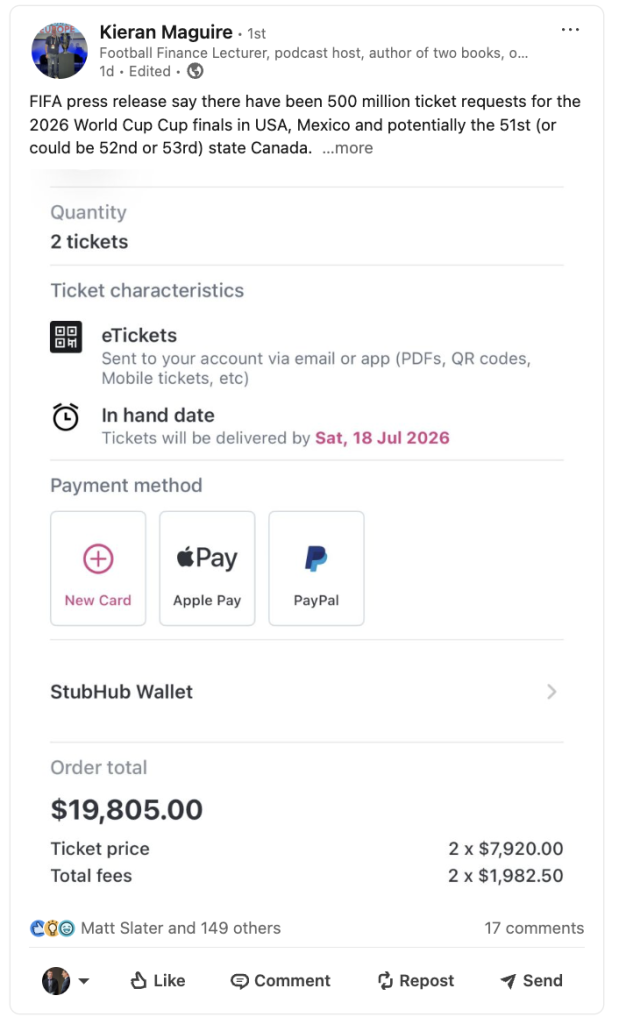
The reported 500 million requests has been a particular talking point online for many following World Cup preparations closely, including football finance expert Kieran Maguire.
Maguire, who is co-host of the Price of Football Podcast, highlighted the size of the figure on LinkedIn: “There are 8 billion people on the planet, so if we exclude 2 billion as being too young or old to attend, it works out as 1 in 12 people have applied for tickets…unless there have been multiple applications from bots, touts, organised crime, chancers, flippers…and the occasional genuine fan.
“Why? Because the World Cup represents in a digital era an opportunity to make a quick buck by reselling the tickets, and the resale sites are cashing in too, even though in theory they are not allowed to sell tickets, as FIFA has appointed itself (at 30% commission) as the only reseller.”
FIFA has defended the legitimacy of its numbers, stating each application was validated using unique credit card data to prevent duplication.
With households allowed to submit one application covering up to 40 tickets across dozens of matches, and millions of households worldwide chasing a 104-match tournament, the overall volume of ticket requests could theoretically reach 500 million.
Industry concerns over bots and grey markets
Speaking to Insider Sport, Chris Newbold, Co-founder of sports hospitality provider Vision4Sport, says the size of the figure points to structural issues within global ticketing systems rather than organic fan demand alone.

“It highlights the advancing technology of touts and bots — as ultimately, there is no way that these numbers are legitimate, in the sense of individual users signing up,” Newbold says. “That would be completely unprecedented, and unrealistic.”
He also explains modern ticketing infrastructure is increasingly being exploited by organised operators rather than informal resellers.
“There is still a huge grey market for this type of major tournament when it comes to ticketing, and ‘reputable’ sites are operating as non-official partners,” he says.
“Essentially, what would once have been your man on the street flipping tickets is now massive multi-national corporations working in the same way, on a much larger scale, backed by advancing technology.”