



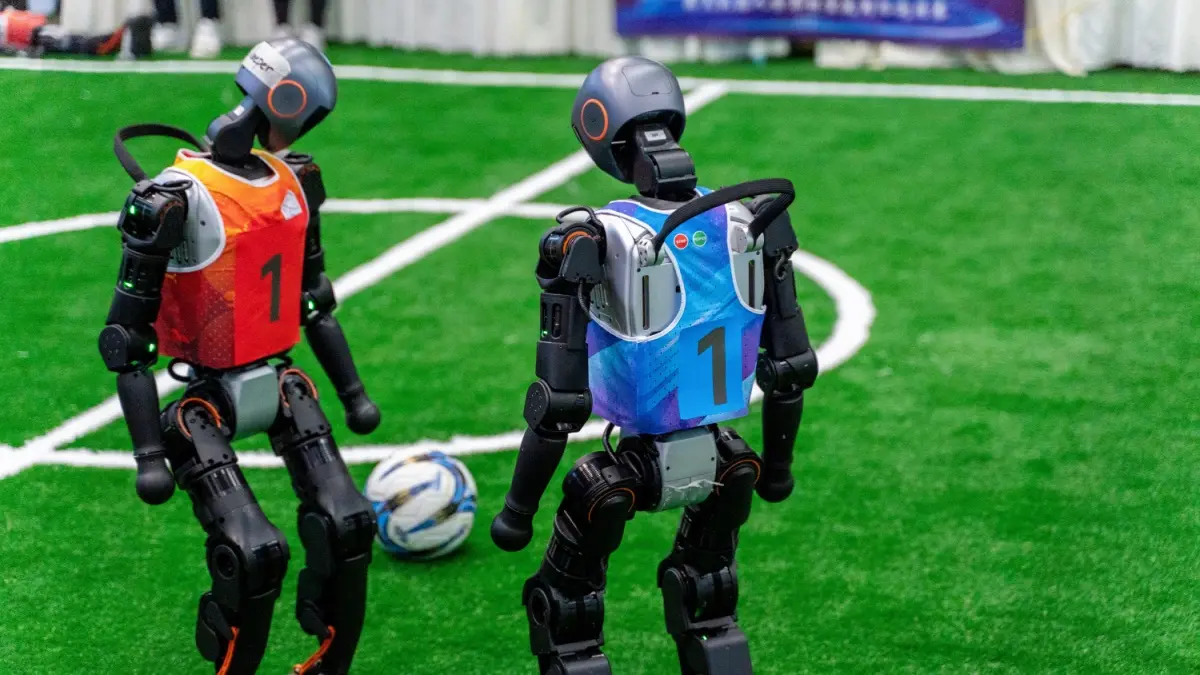
The World Humanoid Robot Games give China a public stage to show how quickly the technology is progressing.
A robot has beaten Usain Bolt’s 100m world record at the World Humanoid Robot Games, but the event is about much more than surpassing the achievements of athletes.
The robot, developed by the Beijing Innovation Centre of Humanoid Robotics, completed the 100m in 9.39 seconds, beating the 9.58-second record Bolt set at the 2009 World Athletics Championships.
This year’s Games, being held at Beijing’s National Speed Skating Oval from 22 to 26 August, feature 2,056 robots from 666 teams, an increase from the 280 teams that entered the inaugural edition last year.
The programme has also jumped from 26 events to 51, covering sports such as football and running, as well as challenges to test how robots handle everyday tasks.
Un robot humanoïde chinois vient de dépasser le meilleur humain à la course
— Docteur Laurent Alexandre (@dr_l_alexandre) August 22, 2026
100 mètres en 9,39 secondes
C’est plus rapide que Usain Bolt qui a fait le 100 mètres en 9.58 secondes
pic.twitter.com/j2quE0gI0x
Sports used to test humanoids
Sport is a perfect way to test robots because many of the same qualities demanded of human athletes, including movement, balance, coordination and decision-making, can be measured under competitive conditions.
Teams also get an immediate comparison with rivals, allowing developers to see where their robots perform well and where improvements are still needed.
Progress since the first Games has been noticeable, as the winning robot completed last year’s 100m in 21.50 seconds, meaning the fastest time has fallen by more than 12 seconds in just a year.
Football has developed too, with robots able to dribble, shoot and make saves, and this year’s programme has added more visually ambitious events including dancesport, martial arts and weightlifting.
The sporting format also provides robotics with a spectacle which isn’t something that laboratory testing can provide.

Athletics and the Olympics have used records to show audiences the limits of human performance and newer competitions such as the Enhanced Games have also adopted their appeal on the possibility of pushing those limits further through technology and performance enhancement.
The Enhanced Games, which launched in Las Vegas this year, were backed by investors including Peter Thiel, with organisers stating that competition can provide a public stage for technological and scientific progress.
Robot sport is working in a similar way by attracting the attention of people outside engineering circles, giving fans, investors and potential commercial partners an easier way to understand how quickly the technology is developing.
A small improvement in balance or control may not mean much to the average viewer, but a robot running 100m faster than Bolt makes progress into something recognisable.
However, like the Enhanced Games, which is using competition to promote the performance-enhancing products used by its athletes, the robot Games also have a secondary purpose of showcasing technology that developers want to commercialise.
China is also using the Games to test more practical applications, with 21 scenario-based events this year covering areas such as housekeeping, firefighting and retail.
Attention helps attract investment
The robots may be breaking records, but the Games have also made their current limitations extremely clear.
In one 100m race, the leading robots struggled to stop cleanly, crashing into padded barriers at the end of the track, with one falling over and needing to be carried away.
Moments like this have helped the competition attract attention outside robotics circles, making achievements and failures both valuable to the sector.
机器人跑太快不及刹车,撞上垫子后把腰折断了🤯 pic.twitter.com/wwJ4HfgiC5
— 偏航 (@pianhangx) August 20, 2026
This attention comes as investment continues to rise in the industry, with Unitree raising around $900m through its Shanghai listing earlier this month. The company’s shares closed 460% above the initial public offering price on their first day of trading, valuing the company at around $50bn.
Xpeng, the Chinese electric vehicle manufacturer, announced earlier today (24 August) that its robotics arm had raised more than $900m in its first funding round, valuing the business at more than $6.3bn.