


BBC’s Champions League deal increases fans but may offer a commercial reality check on women’s football, certainly from a broadcasting standpoint.
BBC Sport has agreed a five-year deal to broadcast the UEFA Women’s Champions League, hoping to carry the momentum from the Lionesses’ Euro win earlier this year.
Under the agreement, announced on October 1, the free-to-air broadcaster will show up to seven live matches each season. The package includes the final, both legs of one semi-final and four early-round matches.
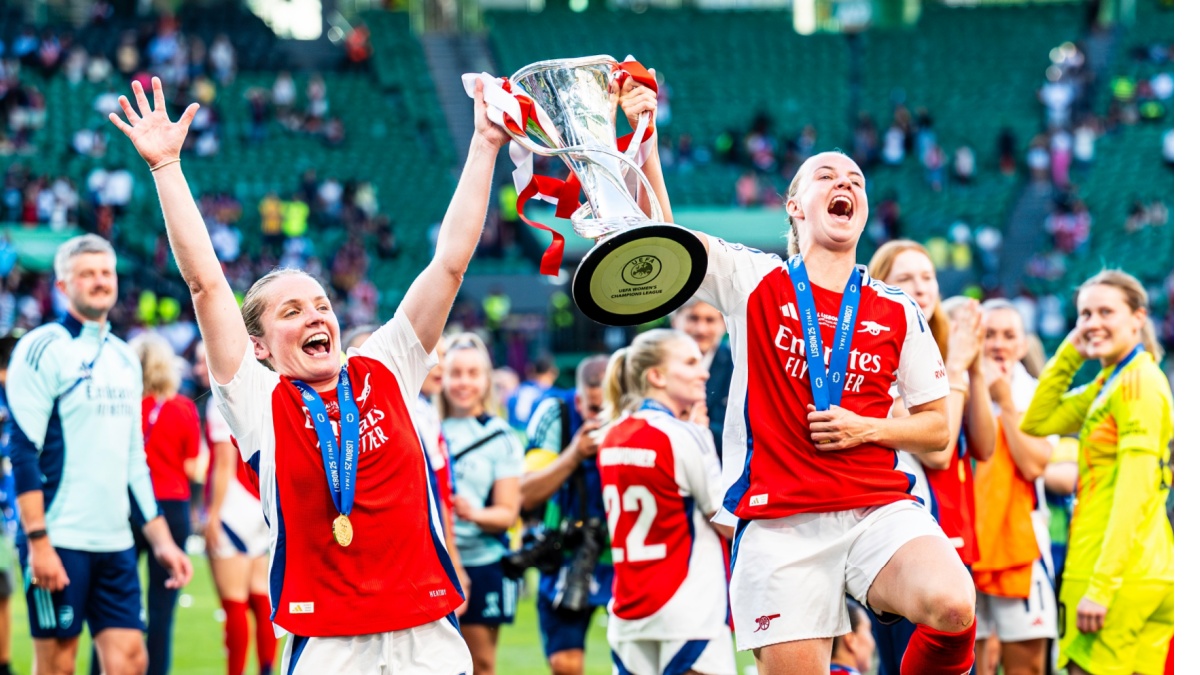
Arsenal claimed last season’s trophy, becoming the only English team to win the tournament twice.
This deal represents a major win for BBC, which shared rights to Euros 2025 with ITV, a tournament which saw the Lionesses lift the trophy for a second consecutive time and draw record audiences.
“This is a great moment for women’s football and for BBC Sport. Bringing the UEFA Women’s Champions League to a free-to-air audience is huge, but what makes this truly game-changing is our digital offering,” said Alex Kay-Jelski, Director of BBC Sport.
“Our multi-platform strategy means fans won’t just watch the biggest games live on TV, they’ll experience the best moments, goals, and highlights across our website, app, and social media platforms. We’re making the competition more accessible, more visible, and more connected than ever before.”
A focus on reach
Free-to-air coverage has already proven effective at growing audiences for women’s football. ITV1’s broadcast of the Lionesses’ 6-1 group stage win over Wales attracted a peak audience of 4.6 million viewers across all devices.
This is particularly impressive when considering that Channel 5’s coverage of Chelsea’s 3-0 Club World Cup final victory over PSG, happening at the same time, peaked at just 2.4 million viewers.
The Women’s Super League (WSL) has also benefited from free streaming. After all 66 non-nationally televised matches were made available on YouTube in 2024/25, viewing figures reportedly tripled.
While free access isn’t the only factor, it appears to be influencing attendance as well. According to WSL Analytics, the 2025/26 WSL season opener saw 95,213 spectators across 12 fixtures, up 16.4% from the previous year, averaging 7,934 per match.
Despite these gains, the women’s club game still faces commercial hurdles. Unlike the men’s UEFA Champions League, which moved to exclusive subscription channels like the then BT Sport from 2015, the women’s game generates far less direct broadcast revenue.
Free-to-air deals may boost audience engagement, grow the fan base, and attract new sponsors, but they are unlikely to match the financial value of exclusive pay-TV rights.
This may seem at odds with current discussions about commercialising women’s football. While there is undoubtedly a push to drive revenue for clubs, it’s important to have the sport’s foundations in place first.
With the BBC deal, women’s football can reach a wider audience, strengthen digital engagement and attract new sponsors. Free-to-air may show the current limits of the women’s game commercially, but past examples suggest it is far from a negative step.